
The Chief Minister’s Arithmetic
“For every one Hindu that has left, two Muslims have come in.” M.A. Khuhro said it in 1948. The number he named points past what the census ever captured.

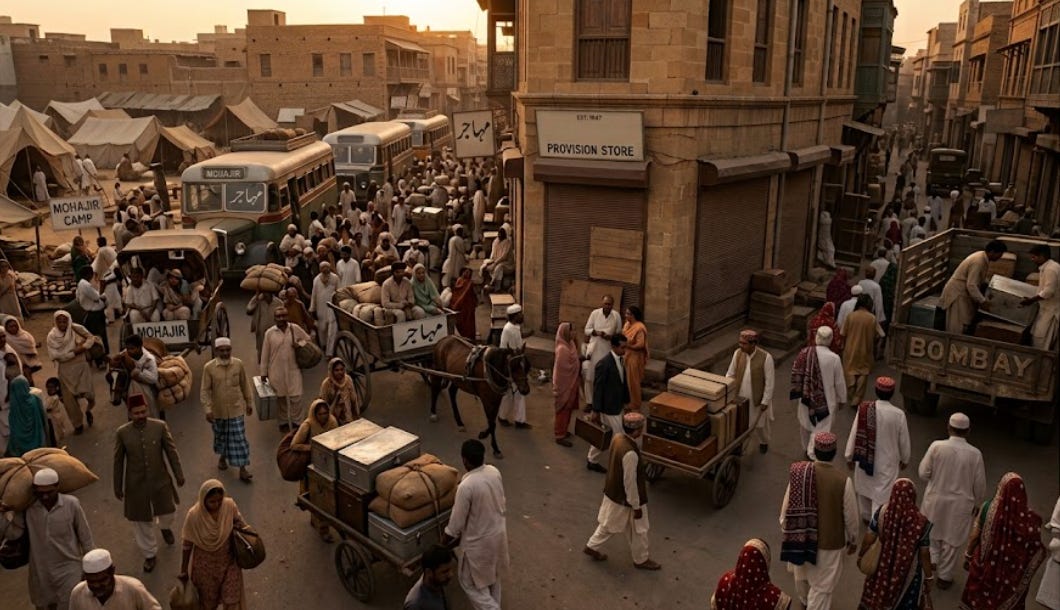
In January 1948, the man running Sindh did the arithmetic out loud. Migrants from Punjab were piling up in camps to the north, a quarter of a million of them sleeping in the open, and the federal government wanted Sindh to take the overflow. Sindh’s Chief Minister, M.A. Khuhro, set a ceiling of 100,000 and refused to move it. His reason was a ratio. “For every one Hindu that has left,” he said, “two Muslims have come in.”¹
Twelve words, spoken by the official with the province’s own figures in front of him, and they carry a claim the later record never quite catches. Two arriving for every one leaving is not a population exchange but a replacement, and the replacement ran ahead of the departure. The people leaving were Sindh’s commercial and professional class. The people arriving were strangers to the province, mostly headed for one city. Inside five years the social order of Sindh was rebuilt from the outside, and the census that recorded it became a fight over who the place now belonged to.
Karachi: a city turned over in a decade
Start with the one place the census measured cleanly. Karachi was a port city with a Hindu plurality and a Muslim minority when Partition arrived. Ten years later it was the opposite, on every axis the census tracked. Sarah Ansari, the leading historian of post-Partition Sindh, reproduces the comparison directly from the census findings.²
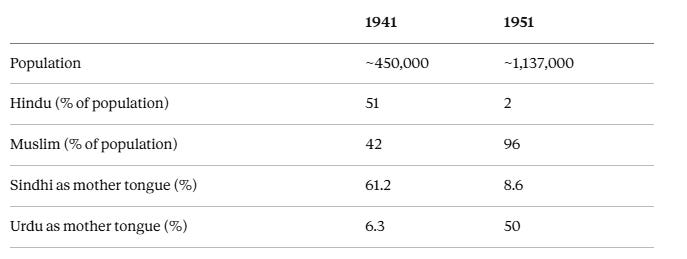
Every line is a different way of saying the same thing. A Hindu majority became a rounding error while the Muslim minority became near-totality, and the language of the streets flipped from Sindhi to Urdu. That last shift is the linguistic fingerprint of the new arrivals: the Mohajirs who came from north India spoke Urdu, and within ten years half the city did.
The raw growth tests Khuhro’s ratio in the one place the census measured cleanly. Between 1941 and 1951 Karachi added roughly 691,000 people, a 158.4 per cent increase.³ By the 1951 count, migrants from India made up more than half the population of the Federal Capital Area.⁴ The city did not absorb newcomers into an existing body. The newcomers became the body, and the arrival side of his two-to-one ran, if anything, steeper than he claimed.
The census attached its own caveat. Its Commissioner, E.H. Slade, recorded “a grave doubt” as to whether the major cities, Karachi above all, had been fully enumerated.⁵ The man who signed the count flagged his own undercount, with Karachi singled out. The direction of the change is not in question. The third decimal place is.
Sindh province: the count that came in
Karachi took the largest share of the inflow, but the inflow was province-wide. By 1949, more than 700,000 incomers had arrived in Sindh, most heading for Karachi and the rest settling across the other towns, a movement that kept running into the 1950s.⁶
The Punjab-overspill fight is where Khuhro’s ratio was spoken, and the context sharpens it. He invoked two-to-one not to boast but to refuse: the province, by his count, had already taken in more than it could hold, so he capped further intake at 100,000. The federal Minister for Refugee Rehabilitation, Ghazanfar Ali Khan, rejected the idea that any province could limit its share at all. He called the cap a “virus of provincialism” that betrayed both Islam and the cause Pakistan had been won for, and warned it would “destroy the very foundations of our newly born state.”⁷ The cap did not hold. More than 200,000 migrants came anyway, travelling from early September at about 5,000 a day, 2,500 to a train.⁸ The man who governed Sindh named a ratio to slow the inflow, and the inflow overran both his number and his ceiling.
The arrivals were not a cross-section. They were disproportionately urban, literate, and skilled, which is why they concentrated in Karachi and the towns rather than spreading evenly across the countryside. A later Census Bulletin put Karachi’s growth among the new country’s “outstanding phenomena,” ranking the city with Athens, Birmingham, Glasgow, Milan, Melbourne, and Montreal for sheer size.⁹ The state read the transformation as an achievement. From where the federal authorities sat, a Sindhi-Hindu port had become a Pakistani metropolis, and the official conclusion drawn from the census was that neither the Mohajirs nor the Sindhis could claim it as theirs alone.¹⁰
The number that has to be inferred
The census recorded who arrived. It asked migrants directly whether they had moved because of Partition, so the inflow was counted. It did not count who left. Departure has to be inferred by comparing one census against the next, which makes every outflow figure an estimate rather than a tally.
The most precise documented number is for the first wave, not the whole exodus. Nandita Bhavnani, whose study of the Sindhi Hindu migration is the standard work on it, records that of roughly 290,000 Sindhi Hindus who left between August 1947 and mid-January 1948, around 240,000 went to Bombay province.¹¹ The pull toward Bombay had a plain cause: Sindh had until recently been part of the Bombay Presidency, and its colleges still answered to the University of Bombay. The first wave followed an existing road.
That 290,000 covers the opening months and the trigger event, the Karachi violence of January 1948, after which departure accelerated. The full Sindhi-Hindu exodus over the following years runs well above it, into the range of a million or more in the wider scholarship, but those totals are aggregates built from inter-census comparison, and they should be carried as named-scholar estimates, never as a census fact. The early wave is documented to the tens of thousands; the full total is an informed estimate to the nearest several hundred thousand.
What is not soft is the character of who left. The departing Hindus were, across Sindh, the merchants, financiers, professionals, and clerks who had run a large part of the province’s commercial and administrative life. Their exit is why the inflow mattered so much. A vacated shopkeeper class and a vacated professional bureaucracy is precisely the space the incoming Mohajirs moved into, and precisely the property the evacuee-property regime was set up to administer. Ian Talbot puts the mechanism plainly: the recovery from Partition mostly took the form of migrants stepping into the business openings left by the departing Hindus and Sikhs, sharpest in the cities of Sindh, where the Mohajirs filled the shoes of the non-Muslim commercial elite because the native Sindhis lacked the capital and skills to compete for them.¹² The numbers and the property question are the same question seen twice.
Why the count became a war
A census is supposed to settle facts. This one set off a fight that ran for a generation, because the facts it recorded were the facts both communities would build their claims on.
Sindh had already lost its capital to the arithmetic. In July 1948, Karachi and its surrounding area were carved out of the province and made federal territory, the country’s capital sitting on ground that had been Sindhi months earlier. A contemporary observer said the province had been “beheaded.”¹³ The remainder was renamed and reduced. A Finance Minister described what was left as “a very small province with very limited resources.”¹⁴ The numbers did not just describe Sindh’s transformation; they were used to redraw its map and shrink its standing.
The deeper collision came later, and it came through the census categories themselves. The 1951 count had certified a new linguistic reality: a large, declared Urdu-speaking population now anchored in Sindh’s cities. By the early 1970s that certified fact had become a political fault line. In July 1972, the provincial government introduced a bill making Sindhi compulsory in schools and raising the prospect of it displacing Urdu in local offices and courts. Language riots followed.¹⁵ Then in 1973 a federal job-quota system split Sindh’s roughly 20 per cent share of government posts into rural and urban halves, 11.4 per cent and 7.6 per cent, with Sindhis falling mostly into the rural category and Mohajirs into the urban one, a division that threatened Mohajir access to federal employment and fed the rise of Mohajir ethnic politics in the decade that followed.¹⁶
The category that got thrown away
The 1973 split rewarded a particular way of drawing the line, and the line it drew has cost the people who accepted it ever since. Do the arithmetic the census invites.
Start with who the Muslims of 1951 Karachi actually were. The census counted 96 per cent of the city as Muslim, about 1,091,500 people out of 1,137,000. It also counted mother tongue. In 1941, 61.2 per cent of the city spoke Sindhi; by 1951, only 8.6 per cent did. Of that 8.6 per cent, two points were the residual Hindus. Subtract them and Sindhi-speaking Muslims came to at most 6.6 per cent of the city, roughly 75,000 people. The figure is an upper bound, because some of the remaining Hindus spoke Gujarati rather than Sindhi, which would push the Sindhi-Muslim share lower still.
Set that against the Muslim total and the gap is the whole story. Non-Sindhi-speaking Muslims were 96 minus 6.6, or 89.4 per cent of 1951 Karachi, about 1,016,000 people. These were the migrants and their families: Urdu-speakers, and alongside them Gujarati, Punjabi, Memon, Kutchi, and Marwari-origin Muslims who had crossed for Partition or arrived from elsewhere in West Pakistan.
A second calculation confirms the scale from the other direction. Only 189,000 Muslims lived in Karachi in 1941. Natural increase on that base across a decade, even at a generous one to two per cent a year, adds at most thirty to forty thousand. The city held 1,091,500 Muslims by 1951. Everything above the grown native base, on the order of 860,000 people, three-quarters of the entire city, had to come from outside. The census said as much in its own words, recording that migrants from India alone made up more than half the Federal Capital Area. Half is the Mohajirs from India; three-quarters is those migrants plus the Muslims who came from elsewhere in West Pakistan, chiefly Punjabis moving south into the new capital. East Pakistan does not enter the arithmetic here: the large Urdu-speaking flow of this decade ran the other way, into East Bengal, and the Bihari movement from the east into Karachi belongs to the years after 1965 and 1971, outside this count.¹⁷ The two figures bracket the same reality.
One number gets misused here. Sindh’s recorded birth rate in 1941 was about 56 per 1,000, a birth rate, not a growth rate.¹⁸ Growth is births minus deaths, and the 1940s carried death rates high enough to cancel most of those births, which is why natural increase ran at one to two per cent a year rather than five or six. Building the native base on the birth rate alone would inflate it several times over. Netting out the era’s mortality leaves the in-migrant share where the second calculation puts it: the overwhelming majority of the city.
Now hold two numbers next to each other. Non-Sindhi-speaking Muslims in 1951 Karachi: 89 per cent. Urdu specifically as mother tongue: 50 per cent. That 39-point gap is the foot the movement would later shoot.
In 1951, “Mohajir” meant migrant. The census category that carried the weight was migration status, and on that definition the new arrivals were not a bloc of Urdu-speakers but a coalition of everyone who came: the Gujarati trader, the Punjabi Muslim, the Memon and Kutchi businessman, the Urdu-speaking clerk from the United Provinces, all of them migrants, all of them part of the same demographic wave that had replaced the Sindhi-Hindu order. Defined that way, the migrant population commanded something close to nine-tenths of Karachi. At national scale the imbalance runs the other way: across all of Pakistan, roughly three-quarters of the Mohajirs were Punjabis, some 4.7 million people, two-thirds of them agriculturalists.¹⁹ The Urdu-speaking Mohajir of the popular imagination, the UP and Bombay clerk who landed in Karachi and Hyderabad, was always a minority of the country’s migrant Muslims. Sindh’s cities were where that minority concentrated, which is exactly why a Mohajir identity pegged to Urdu could speak for Karachi and almost nowhere else.
When the Mohajir political movement of the 1980s redefined “Mohajir” as “Urdu-speaker,” it walked away from the other forty points. A category that commanded the city was narrowed to the half of it that spoke Urdu. Every Gujarati-speaking, Punjabi-speaking, Memon, and Kutchi Muslim migrant, people who were Mohajir in the original, migration-based sense, was defined out of the coalition. A would-be majority became one ethnic faction among several. The quota had already cut urban Sindh’s job share to 7.6 per cent; tying Mohajir identity to language alone then surrendered the numerical weight that the broader migrant identity would have carried into that fight. The movement chose the smaller number, and has lived inside it ever since.
Mother tongue is not identity, and not every Punjabi or Gujarati Muslim migrant would have called himself Mohajir even in 1951. What the numbers establish is narrower and still decisive: the migration-based category was demographically vast, the language-based one was roughly half its size, and choosing the second over the first had a measurable cost that the cities have paid in every count since.
The same arithmetic, province-wide
Khuhro spoke for the province, not the city, so run his ratio across Sindh as a whole. The 1941 base is firm: a province of 4.84 million, about 71 per cent Muslim and 26 per cent Hindu.
Apply the Chief Minister’s two-to-one to the Hindu departure and the output runs into the millions, but every term in that multiplication is soft: the Sindhi-Hindu exodus is an inferred total, not a census count, and the ratio was Khuhro’s rhetorical figure, not a measured one. The reported anchor is firmer and points the same way. Ansari’s archival figure already passes 700,000 incomers by 1949, early in the movement, with arrival continuing into the 1950s, so even the documented count, before any extrapolation, establishes an inflow large enough to remake the province.²⁰
One reported figure puts a hard ceiling on the whole exercise and settles the birth-rate question for good. Across the entire Partition decade, Sindh’s population grew by 11.9 per cent, the inflow included.²¹ A province cannot absorb a million-plus migrants, lose much of its Hindu population, and still post only 11.9 per cent net growth unless natural increase among those who stayed was modest, well under two per cent a year. A crude birth rate of 56 per 1,000 read as a 5.6 per cent growth rate would have produced something several times larger than the census actually found. The decadal figure is the proof: most of those births were cancelled by deaths, and the visible change in the province is migration, not breeding.
Where the migrants went is reported too. Ansari’s breakdown of migrant settlement across Sindh, excluding Karachi, shows them piling into a handful of urban districts and largely skipping the rural interior.
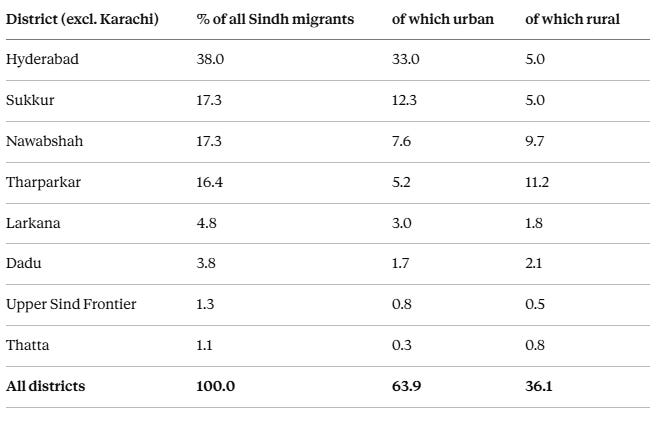
Hyderabad alone took 38 per cent of the province’s migrants, with Hyderabad, Sukkur, and Nawabshah together holding nearly three-quarters of them.²² Across residual Sindh, about 64 per cent of migrants settled in towns and only 36 per cent in the countryside, and the urban share concentrates further once Tharparkar is set aside, the one district where settlement was overwhelmingly rural rather than urban, 11.2 per cent rural against 5.2 urban in Ansari’s table, reflecting a desert border crossing rather than the town-bound movement everywhere else. The rural Sindhi-Muslim heartland was barely touched. The migrants became an urban phenomenon, stacked into Hyderabad and Sukkur the way they had stacked into Karachi.
The provincial total and the urban total tell opposite stories, and both are true. Run across the whole province, native Sindhi Muslims remained the large majority; the rural districts stayed overwhelmingly what they had been. Run across the cities, the migrants dominated, in Karachi above all but in Hyderabad and Sukkur as well.²³ A Sindhi-majority province containing a migrant-majority set of cities.
That gap is why the census in Sindh has never been left alone. Every prize the state hands out keys off a category share in the count. The 1973 quota divided jobs by rural and urban. Assembly seats divide by population. Language status, school instruction, the official forms in a government office, all of it follows from which boxes the census says are how full. A provincial total foregrounds the Sindhi-Muslim majority. An urban total foregrounds the Mohajir majority. They point to opposite winners, so the count itself becomes the contest. Whoever sets the questions, who is rural and who is urban, whose mother tongue is recorded as what, whether a city is enumerated fully or not, is setting the allocation a decade in advance.
The gaming ran in both directions from the start, and the first census already shows it. The 1951 count put Karachi at 51 per cent Mohajir, but Ansari notes the figure was probably low, because many who declared they had been born in the city were likely migrants trying to avoid being resettled in the interior of Sindh, which made the 41.5 per cent claiming the city as birthplace unrealistically high.²⁴ The migrants had a reason to under-declare their migrant status: the state was trying to push them out of Karachi and into the districts, and a city birthplace was a defence against relocation. So the contest over how Sindh is counted is not a recent Sindhi invention pressing on an honest baseline. It was there in the first enumeration, with migrants themselves shading their answers, because everyone understood even then that the boxes on the census slip decided who got the city and who got sent to the interior. The recurring fight over the count is not a quarrel about accuracy; it is a quarrel about who gets the province, run through the one instrument that decides it.
The language data shows the same fault line from another angle. Province-wide, Sindhi as a mother tongue barely moved, 70 per cent in 1941 to about 62 per cent in 1951. In Karachi it fell off a cliff, 61.2 to 8.6. The Mohajir influx was overwhelmingly urban; it left the provincial language balance close to intact while remaking the cities completely. Across all of Sindh in 1951, roughly 38 per cent did not speak Sindhi as a mother tongue, and that share was mostly Muslim migrants of every language, the broad Mohajir constituency. Urdu specifically, province-wide, was far smaller, concentrated in Karachi and a handful of towns. A migrant identity built on migration could lay claim to better than a third of the province and a clear majority of its cities. A migrant identity built on Urdu alone could claim neither. The movement reached for the definition that fit the fewest people, and the census numbers had been showing the cost of that choice since the first count after Partition.
Khuhro named his ratio to win a budget fight, and lost it. The number outlived the argument. Two for every one was never a precise census line, but it caught a scale the official tally keeps rounding away: a province whose social order was replaced from the outside, faster and more completely than a count of net migration lets on. The law settles who held a rightful claim to what was left behind. The arithmetic the Chief Minister did out loud in 1948 settles how much was left behind, and how little of the old Sindh remained to claim it.
A note on the figures. Almost everything here is reported directly by Sarah Ansari in Life After Partition from the 1951 census and the contemporary record: the Karachi census table, the provincial inflow of 700,000-plus by 1949, the urban-rural migrant distribution, the 11.9 per cent decadal growth, the 51 per cent Mohajir share of Karachi and its undercount, the Khuhro and Ghazanfar Ali Khan statements, and Slade’s enumeration caveat. The 89 per cent non-Sindhi-speaking-Muslim figure and the three-quarters in-migrant figure are arithmetic on the census table, derived in the text with the one assumption stated. The first-wave outflow of 290,000 is Bhavnani’s. Two figures are models, not counts, the Sindhi-Hindu exodus multiplied by Khuhro’s ratio, and a full reconstruction of the province’s native-to-migrant balance; both sit in the notes, flagged, and neither carries a claim in the body.
Postscript References
M.A. Khuhro, quoted in Dawn (Karachi), 18 January 1948; cited in Sarah Ansari, “Pakistan’s 1951 Census: State-Building in Post-Partition Sindh,” Royal Holloway, University of London research repository, drawing on First Census of Pakistan 1951 and Ansari, Life After Partition: Migration, Community and Strife in Sindh, 1947–1962 (Oxford: Oxford University Press, 2005).
Comparison of 1941 and 1951 census findings for Karachi, reproduced in Sarah Ansari, “Pakistan’s 1951 Census: State-Building in Post-Partition Sindh,” from First Census of Pakistan 1951; table data drawn by Ansari from Arif Hasan and Masooma Mohib, Urban Slums Reports: The Case of Karachi, Pakistan (2003).
Ansari, “Pakistan’s 1951 Census,” citing the Karachi figures from the 1951 census; see also Sultan S. Hashmi, The People of Karachi: Demographic Characteristics (Karachi: Pakistan Institute of Development Economics, 1965), p. 19.
Census Bulletin No. 3, Office of the Census, Government of Pakistan, Ministry of the Interior (Karachi, September 1952), p. 2, cited in Ansari, “Pakistan’s 1951 Census.”
E.H. Slade, Census of Pakistan 1951, Pakistan Report and Tables, Vol. 1 (Karachi: Manager of Publications, Government of Pakistan, 1955), p. 2, cited in Ansari, “Pakistan’s 1951 Census.”
Ansari, “Pakistan’s 1951 Census,” citing Ansari, Life After Partition, Chapter 5.
Ghazanfar Ali Khan, quoted in Dawn (Karachi), 24 February 1948; cited in Ansari, “Pakistan’s 1951 Census.”
Ansari, “Pakistan’s 1951 Census,” drawing on the contemporary record of the Punjab-overspill migration; see also Dawn (Karachi), January–February 1948.
Census Bulletin No. 3 (September 1952), p. 2, cited in Ansari, “Pakistan’s 1951 Census.”
Ansari, “Pakistan’s 1951 Census,” summarising the federal reading of Karachi’s post-census demographic position.
Nandita Bhavnani, The Making of Exile: Sindhi Hindus and the Partition of India (New Delhi: Tranquebar/Westland, 2014); first-wave migration figures as reviewed in Dawn (Karachi), 21 December 2014.
Ian Talbot, Pakistan: A Modern History (London: C. Hurst & Co., 1998; ISBN 1-85065-385-2), p. 121. Talbot describes the post-Partition economic recovery as mainly a matter of refugees moving into the openings left by departing Hindus and Sikhs, a process he records as “most marked in the cities of Sindh,” where the Mohajirs took over the non-Muslim commercial elite’s position while native Sindhis lacked the capital and skills to compete.
Contemporary observer quoted in Dawn (Karachi), 10 February 1948; cited in Ansari, “Pakistan’s 1951 Census.”
Sindh Finance Minister, 1949 budget speech, quoted in Commerce (20 August 1949); cited in Ansari, “Pakistan’s 1951 Census.”
Ansari, “Pakistan’s 1951 Census,” on the Teaching, Promotion and Use of Sindhi Language Bill (July 1972) and the language agitation that followed.
Ansari, “Pakistan’s 1951 Census,” on the 1973 federal quota system (rural 11.4 per cent, urban 7.6 per cent) and its role in the emergence of Mohajir ethnic politics; for fuller context see Laurent Gayer, Karachi: Ordered Disorder and the Struggle for the City (London: Hurst, 2014).
On the direction of Muslim migration in this period: the major Urdu-speaking and Bihari Muslim flow of 1947 onward was into East Pakistan, not out of it, with up to roughly a million eventually settling in East Bengal. The substantial movement of Biharis and other Urdu-speakers from East Pakistan to Karachi came after the 1965 war, which closed the Rajasthan-Sindh land route, and above all after the 1971 secession of Bangladesh. None of that falls within the 1941-51 decade these figures cover. See “Persecution of Biharis in Bangladesh” and Omar Khalidi’s work on Indian Muslim migration to Pakistan, as summarised in the standard reference accounts of the Bihari migrations.
Census of India 1941, Vol. XII (Sind) (Delhi: Manager of Publications, 1942), recorded birth-rate tables (approximately 56 per 1,000). The conversion of a crude birth rate into a population growth rate requires netting out the period death rate and is not performed in the source; the period’s net natural increase was modest, well under two per cent a year, consistent with mid-twentieth-century South Asian demographic conditions and confirmed by the provincial decadal growth figure in the following note. The 1941 Sindh provincial breakdown (total 4,840,795; Muslim 71.5 per cent; Hindu 26.4 per cent) is the district-level aggregation of the same census.
Talbot, Pakistan: A Modern History, p. 121 and n. 110: roughly three-quarters of all Mohajirs were Punjabis, about 4.7 million, two-thirds of them agriculturalists, citing K. Sipe, “Karachi’s Refugee Crisis.” The Punjabi Mohajirs settled overwhelmingly in West Punjab; the Urdu-speaking UP and Bombay Mohajirs were the stream that concentrated in Karachi and the other Sindh cities.
Applying Khuhro’s two-to-one to the Sindhi-Hindu exodus is an illustrative extrapolation, not a count. Estimates of the exodus run from roughly 0.77 million to 1.2 million in the scholarship, themselves inferred from inter-census comparison rather than enumerated; at two Muslim arrivals per Hindu departure this would imply on the order of 1.5 to 2.4 million Muslim migrants into Sindh. Both the exodus total and the ratio are soft, so the product is offered only as an order-of-magnitude check on the reported inflow, which Ansari documents at more than 700,000 by 1949.
Sarah Ansari, Life After Partition: Migration, Community and Strife in Sindh, 1947–1962 (Oxford: Oxford University Press, 2005; ISBN 0-19-597834-X), Table 1 (”Pattern of inward migration to Sindh, 1901–51”), p. 32: decadal population variation of +8.4 per cent (1901–11), −9.1 per cent (1911–21), +18.1 per cent (1921–31), +15.5 per cent (1931–41), and +11.9 per cent (1941–51). The 1941–51 figure is the whole-province change across the Partition decade, inflow included.
Ansari, Life After Partition, Table 2 (”Urban-rural distribution of refugees in Sindh, 1951” [excluding Karachi]), p. 76: Hyderabad 38.0 per cent of the province’s refugees (33.0 urban / 5.0 rural), Sukkur 17.3 (12.3 / 5.0), Nawabshah 17.3 (7.6 / 9.7), Tharparkar 16.4 (5.2 / 11.2), Larkana 4.8, Dadu 3.8, Upper Sind Frontier 1.3, Thatta 1.1. Urban and rural columns sum to roughly 64 per cent urban and 36 per cent rural across the residual-Sindh refugee population.
A reconstruction of residual Sindh’s full 1951 population, built from the 1941 provincial base and the documented flows, puts native Sindhi Muslims ahead of Muslim migrants by roughly eight or nine to one across the province as a whole, against something nearer one to four inside Karachi. This is a model, not a reported figure: it depends on assumed natural-increase rates and an assumed split of the inflow between Karachi and the interior, neither of which exists as an enumerated number. It is given here only to indicate magnitude. The direction it illustrates, a Sindhi-majority province whose cities held a migrant majority, is reported fact, established by the urban-rural settlement pattern in Ansari’s Table 2.
Ansari, Life After Partition, p. 127 and Table 3 (”Place of origin of refugees in Karachi, 1951”): refugees totalled 616,906, or 58.5 per cent of the city; the census recorded Karachi as 51 per cent Mohajir, which Ansari characterises as probably a low estimate, since many declaring city birth may have been refugees seeking to avoid resettlement in the interior, making the 41.5 per cent giving the city as birthplace unrealistically high.