
Chapter 9: Why Anger Keeps Failing
The Captured Republic

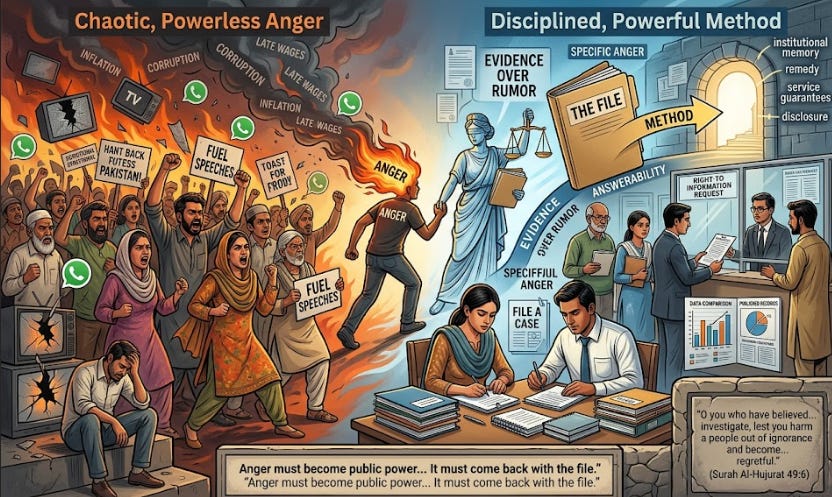
The wages are late again, the inheritance went to a brother, the public medicine was sold outside, and everyone involved is furious. Pakistan has no shortage of that fury. It fills drawing rooms, tea stalls, universities, mosques, offices, WhatsApp groups, television studios, court corridors, markets, taxis, homes, and overseas communities. People are angry about corruption, inflation, courts, police, electricity bills, schools, hospitals, taxes, land, jobs, migration, rulers, parties, institutions, elites, families, and the daily humiliation of being forced to ask for what should already work. Much of this anger is earned. A worker whose wages are delayed has reason. A woman pressured out of inheritance has reason. A patient sent outside to buy public medicine has reason. A student trapped by a slow transcript office, a pensioner returning again and again to the same counter, a taxpayer watching protected privilege survive, a citizen watching public land and public money and public contracts serve private advantage. Every one of them has reason.
The problem is not that people feel too little. Anger keeps being defeated before it becomes power. It exposes pain without creating remedy, names betrayal without producing proof, gathers crowds without building institutions, makes a scandal visible without preserving any memory once the scandal fades. It can punish a name and still leave untouched the channel through which the next abuse will travel. A captured order understands this. It survives anger by waiting it out, redirecting it, exhausting it, or splitting it into faction.
The first day of public anger is loud. By the second it is emotional. By the third it has become argument, and by the fourth a new scandal has arrived. Within a week the old wrong is memory without file, outrage without follow-up, pain without ledger. A captured system does not need every citizen to forgive. It needs them to move on before the record is built. It survives not because citizens never notice injustice, but because too many injustices stay unrecorded after they are noticed.
Faction does the rest. One side grows angry only when the other side benefits. A party demands accountability in opposition and discovers complexity in power. A media group chases one scandal and buries another. A religious voice condemns one wrong and avoids a closer one. A professional class demands reform from politicians and resists scrutiny of its own practice. A family condemns national corruption while hiding its own. Selective anger is easy to dismiss: the accused call it politics, the beneficiaries call it hypocrisy, and anger that spares its own group loses its moral force.
So consistency counts more than volume. A society angry only at its opponents is not ready for reform. Ready for rotation. One group replaces another, renames the victims, protects its own networks, and keeps the structure running. The faces change and the method survives. Anger that cannot cross party, class, institution, profession, family, sect, and personal convenience becomes part of the captured order’s weather. Dramatic, and powerless to alter the climate.
Anger fails again when it turns into performance. A speech is made, a clip goes viral, a hashtag trends, a show airs, a protest gathers, a public figure is shamed, a committee is announced, a promise is given. The temperature rises and for a moment the system seems to tremble. But performance is not pressure unless it leaves a record, a demand, a deadline, a follow-up, and a consequence. A captured order is at home in emotional theatre. It apologizes without changing procedure, announces inquiries without publishing findings, suspends a minor official while protecting the chain above him, forms committees without deadlines, praises the public’s pain while refusing the public’s questions, performs sympathy and returns to silence.
Anger without institutional memory becomes fuel for spectacle. People say the system is rotten, the leaders corrupt, the elites shameless, the courts slow, the police politicized, the hospitals broken, the schools useless, the taxes unfair, the young without a future. The statements may be true. While they stay general, power absorbs them. General anger is too large to answer and too vague to enforce; it leaves no specific office, file, budget, beneficiary, rule, timeline, or remedy exposed. A captured order prefers citizens who say “everything is corrupt.” It grows nervous when a citizen says, “this department received this budget, issued this contract, missed this deadline, gave no written reason, and never published the completion record.” The first sentence expresses despair. The second builds a case.
So anger has to get specific. Saying citizens are humiliated is where it starts, not where it stops; the usable question is which service lacks a timeline. Unfair tax becomes a real charge only when it names the exemption, who benefits, what it costs, and when it gets reviewed. A failing hospital is an accusation; what medicine was procured, what was stocked, what went missing, and what patients had to buy outside is a case. Women denied rights is true and inert until someone asks whether female heirs were notified, recorded, and protected before any relinquishment. Slow courts is a complaint; case-age data, adjournment patterns, execution delays, and category-wise backlog is evidence. Specific anger is moral anger made usable.
Some fear that discipline will cool the anger down. The fear is understandable and wrong. A daughter’s stolen inheritance is not a land-record issue. It is betrayal. A worker’s unpaid wage? Theft. A patient forced to buy his own medicine is vulnerability sold back to him. A student losing a year to a delayed document is a life narrowed by indifference. The heat has to stay. But heat needs a vessel to do any work. Undisciplined anger burns and disappears. Disciplined anger marks the file.
A captured order wants anger explosive or exhausted. Explosive anger can be condemned, exhausted anger ignored. Anger that holds is harder to beat because it does not depend on a single moment. It comes back. It records, compares, asks again, publishes the non-response, separates evidence from rumor, protects the claimant, follows the promise after the cameras leave, and outlasts the week after the scandal. It runs on habits: evidence over rumor, public memory over forgetting, service guarantees over patronage, disclosure over opacity, protection over fear, consistency over selective outrage, rights over humiliation, answerability over elite impunity.
None of those habits are glamorous. They give none of the instant satisfaction of denunciation. They ask for patience, files, dates, names, receipts, screenshots, applications, appeals, budgets, minutes, contracts, photographs, status updates, follow-up. They are slower than outrage, and that is their point. Capture survives through repetition and has to be met with repetition. Ask once and record the answer; ask again and record the silence; appeal and track the appeal; compare offices and publish the pattern; protect the claimant and run the method again. Build one district file, then another. Turn one scandal into a case study, the case study into a template, the template into a civic habit. Anger becomes method.
Pakistan does not need less anger. It needs anger that can count, read a budget, file a right-to-information request, the formal demand that obliges a public office to disclose its own records. It needs anger that can ask a hospital about medicine stock, a university about transcript timelines, a court about delay, a tax authority about exemptions, a contractor about wages, a police station about complaint acknowledgment, a land office about female heirs, a public enterprise about losses, a media house about follow-up, and a religious leader about rights before charity. It needs anger that knows the difference between an allegation and a finding.
That difference is the whole discipline. A captured society breeds rumor because its records are weak, and rumor spreads fastest where public information is missing. Rumor is also dangerous: it harms the innocent, weakens serious claims, and hands captured power its favorite excuse to dismiss a whole movement as careless. When a man brought the caliph Umar word that false testimony had spread through his province, the ruling held that no one is detained on an accusation without upright witnesses to support it.¹ The grievance was real; the remedy was still proof, not the grievance by itself. Public accounting has to refuse the same temptation, to turn suspicion into fact. It can say the record is missing, the explanation is inadequate, the timeline was violated, the beneficiary is undisclosed, the claim requires investigation. It cannot pretend to know what it has not proved.
Discipline does not make anger timid. It makes it credible, and credibility is harder to crush than emotion alone. It can stand before a lawyer, journalist, judge, auditor, official, donor, worker, student, or taxpayer and show its basis. It corrects itself when wrong, separates personal insult from public duty, gives the other side a chance to answer where safety allows, shields vulnerable people from being made into symbols without protection, and survives hostile questioning.
Anger fails, too, when people want emotional completion too fast. They want the guilty exposed, shamed, arrested, removed, punished, cursed. Sometimes punishment is necessary; some abuses demand legal consequence. But punishment alone becomes another spectacle when the system that produced the abuse stays intact. One official falls and the office still has no timeline. One contractor is named and procurement stays opaque. One employer is criticized and wage records stay weak. One family is condemned and inheritance safeguards stay absent. One scandal burns and the channel survives. After every scandal the real question is what procedure changed. If none did, the scandal was wasted.
Serious anger works to make the next abuse harder. It asks what record will exist next time, what duty will be published, what reason must be written, what appeal will be available, what protection the claimant will have, what audit will follow, what consequence will apply. It does not stop at expressing pain. It forces the system to leave a trail.
The same exhaustion that wears anger down also pushes it toward a savior. Worn out, it starts hunting for one person to carry the weight: one leader, one judge, one general, one cleric, one technocrat, one party, one billionaire, one activist, one court order, one election, one intervention. The pull is understandable, because discipline is tiring and public work is slow. Following it is also dangerous: it hands citizenship back to dependence and asks a single figure to do what only repeated civic method can sustain.
A republic cannot outsource its anger to a savior. It has to organize that anger into public work, and the work begins at the smallest scale. A residents’ group tracks municipal complaints. A teachers’ group measures learning instead of only enrollment. A lawyers’ group tracks delay in one category of case. A labor group helps workers preserve wage proof. A women’s group monitors inheritance safeguards. A journalist returns to one story after thirty days. A religious leader connects charity to wage, inheritance, and amanah, the trust a person holds on another’s behalf and must answer for. A student group tracks transcript timelines. A diaspora group funds documentation instead of only relief. A citizen keeps one file alive long after the public mood has moved on. None of it satisfies like shouting at the whole system. All of it is more dangerous to capture.
A captured order can live with citizens who shout. It fears the ones who remember, who compare, who tell rumor from record, who do not vanish after the first answer, who hold their own side to the same standard, who turn anger into repeated, lawful, documented pressure. There, anger stops being a mood and becomes public power.
This country does not need another season of outrage followed by resignation. It needs anger that does not burn out after the scandal.
It needs anger that comes back with the file.
Only then does anger begin to win.
The discipline was set down as a command:
O ye who believe! If a wicked person comes to you with any news, ascertain the truth, lest ye harm people unwittingly, and afterwards become full of repentance for what ye have done.²
— Qur’an 49:6 (Yusuf Ali)
Postscript References
Reported in Mālik’s Muwaṭṭaʾ, Book 36 (Judgements): a man told the caliph Umar ibn al-Khattab that false testimony had appeared in his land, and Umar held that none is detained in Islam without upright witnesses. A companion report authentic to the collection.
Qur’an 49:6 (Sūrah al-Ḥujurāt), Abdullah Yusuf Ali translation.