
Chapter 8: The Citizen as Client
The Captured Republic

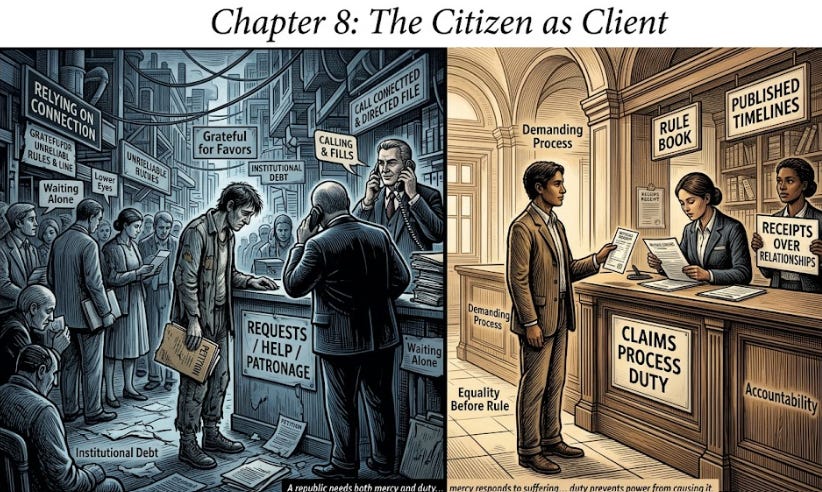
Before he reaches the window, he edits himself.
The sentence he rehearsed at home was simple: this is mine, and it is late. By the time he is third in line, it has softened into something smaller. I wanted to ask about my file, if it is not too much trouble. He drops the part about the delay; it sounded like a complaint, and a complaint needs someone willing to receive it. He is not sure anyone here is. So he files the edge off his own request, the way you round a corner that has cut you before, and steps forward holding a quieter version of what he came to say.
He is not a coward. He has learned. Behind him are the other times: the visit that went nowhere, the form that vanished, the clerk who looked through him until he mentioned a name the clerk knew. Each taught the same lesson, and the lesson has settled into his posture: the direct sentence, the one a citizen is entitled to speak, is read at this window as arrogance, while the humble sentence moves faster. So he speaks the humble one. A small part of him goes quiet that used to know better.
This is the quieter theft inside capture. It takes wages, land, and time, and those can at least be counted. What it also takes leaves no mark on any ledger: the expectation that a person may ask plainly for what is already his. A captured order does not only fail to deliver the right. It trains the one standing before it to stop expecting the right at all, and to feel grateful, in the end, for the favor that should have been a duty.
This change does not arrive all at once. It comes in stages so ordinary that the person living through them rarely notices the sequence. By the end, something in how he understands himself has moved, and he could not say when.
The body learns first. A citizen who has been turned away a few times begins to prepare differently. He carries more documents than the rule requires, because the rule, he now knows, is not the thing that decides. He arrives early and waits without complaint, because complaint has a cost he has already paid once. He watches the faces behind the counters for the one that might soften. He keeps a name in his pocket in case the ordinary route closes: a cousin, a former classmate, a man who knows a man. None of this is written down anywhere as a requirement. He has simply absorbed it, the way the body absorbs any lesson taught by repetition: stand here, not there; ask now, not then; lower the eyes, lift the request. The posture of the supplicant is not chosen. He acquires it, one disappointment at a time.
Then the voice. The client speaks a particular language, and it is not the language of rights. Careful, indirect, faintly afraid. Sir, please see if something can be done. I do not want to create trouble. Whatever you think is appropriate. I will be grateful. I know you are busy. Anthropologists who study people living under power they cannot openly challenge describe a public script the powerless perform in the presence of the strong: deference offered up the hierarchy, the true thought kept private, spoken only offstage among equals.¹ The client speaks this public script fluently. It wears politeness as a mask; underneath is the vocabulary of lowered status, picked up because the other vocabulary, the citizen’s, is punished here.
That other vocabulary still exists, calm without being submissive. Here is my receipt. The published timeline has passed. Please provide the written reason for delay. Which rule applies? Where is the appeal route? Please record my complaint. The same man could speak either language. He has both in him. The distance between them is the distance between a person who belongs to a republic and a person who belongs to a network. On any given morning, standing third in line with something he needs, it takes more spine than most people have to spare to choose the harder one. The humble sentence moves the file. The citizen’s sentence might move it too, eventually, or might mark him as difficult. He chooses the one that works. Each time he chooses it, the choosing gets easier, which is to say the citizen in him gets quieter.
Then the memory. Here the deepest work is done, and done invisibly. When the favor finally comes, the citizen remembers the person who helped, not the institution that failed. The file moved; he recalls the man who moved it. The bed was found; he recalls the doctor’s friend who found it. The complaint was finally heard; he recalls whose call made it audible. What he does not recall, because it has quietly dropped out of the frame, is the prior fact that the file should have moved without a man, that the bed was his by entitlement, that the complaint was supposed to be heard the first time.
The sociologist’s word for this is misrecognition: domination so embedded in ordinary life that its victim no longer perceives it as domination, mistaking an imposed arrangement for the natural order of things.² The system has performed a substitution inside his head, and he was not consulted. Institutional failure has been converted into personal gratitude, and the conversion does not show.
One day the favor comes, like weather breaking. Someone made a call. The file that sat for months moves in an afternoon. The relief is real, and so is the gratitude. He means it when he thanks the man, means it in his chest, the way you mean it when a thing you had stopped hoping for is suddenly in your hands.
And the man who helped knows the worth of what he gave: the gratitude, not the file. He will not name a price today. He does not have to. The debt is understood, the way debts of this kind are always understood: by both parties, in silence, to be called in later. A vote, perhaps. A word in the right room. A turning-up at the rally. A reluctance, when the time comes, to say the wrong thing about the right person. The favor was free the way the first one is always free.
So a second ledger opens beside the first. On the public ledger, nothing: no fee recorded, no service logged, no entry showing that a citizen received what a citizen was owed. On the private one, an amount that never quite gets paid down. He is not a fool; he can feel the hook inside the help. He knows the man gained standing from his need, that his need is the very thing that makes the man worth knowing. He resents it and thanks him in the same breath, because the next file is already coming, and the file after that, and a man who has helped once is the only insurance against the months of silence that are the alternative.
This is the theft with no ledger entry, the one the audit will never find. They took the wage and you could count it. They took the years in line and you could, if you were grim about it, count those too. But this shows up nowhere. The gratitude you feel toward people you resent, for handing you what was already yours, is paid in a currency that leaves no record: a little more of your standing as a citizen, handed over each time, until you have thanked your way out of the republic and into someone’s network, and called it kindness the whole way down.
The humiliation is not distributed equally, and the inequality is the point. At the bottom, clientship is nakedly itself: the poor man waits outside the room, asks plainly for mercy, and is seen to ask. Higher up, the same dependence wears better clothes. The professional does not plead at a counter; he sends a message to a former classmate now placed in the right office. The wealthy man does not wait in any line; he is consulted, invited, brought inside the room as a stakeholder. The mechanism is identical: access flowing through a person rather than a rule.
But its felt cost falls almost entirely on those least able to bear it. The man at the bottom pays in visible deference. The man at the top is spared even the knowledge that he is inside the same system, because for him it has been renamed. What the poor experience as humiliation, the powerful experience as networking. A republic cannot hold when humiliation is something only some of its citizens are required to feel.
None of this requires anyone to love the arrangement. This is its durability. A client may despise the whole structure and remain entirely inside it, because need does not wait for reform. A father with a sick child cannot pause for the health system to be rebuilt. A widow with a frozen pension cannot wait for the office to be redesigned. The structure does not ask for loyalty. It asks only for need, and need it can always supply. So the resentment and the dependence coexist, year after year, and the resentment changes nothing, because every individual case is urgent and the urgency always wins.
Slogans will not bring him back. People will not stop seeking patrons while rights remain unreliable, and telling them to stand tall while the counter still punishes the upright sentence is an insult dressed as encouragement. The citizen returns only when the institution gives him reason to. A service that arrives on time without a phone call; a written acknowledgment handed across the counter; a delay that comes with a reason and an appeal route attached. Each time the rule works without a patron, a little of the standing that was handed away comes back. The body unlearns the crouch the same way it learned it: by repetition, by proof, one ordinary transaction at a time.
The measure of a recovered republic is therefore not whether the powerful are looked after. They are always looked after; power arranges that. The measure is the man with no name in his pocket: no cousin in the department, no classmate in government, no donor, no party behind him. Whether he can walk to the window, speak the plain sentence, and be answered, not because he is connected, useful, grateful, or important, but because he is a citizen.
And until that becomes true, anger keeps rising without becoming power.
A man came to the Prophet ﷺ demanding his debts and behaved rudely. The companions of the Prophet ﷺ intended to harm him, but Allah’s Messenger ﷺ said, “Leave him, for the creditor (i.e. owner of a right) has the right to speak.” — Sahih al-Bukhari 2306³
Postscript References
¹ James C. Scott, Domination and the Arts of Resistance: Hidden Transcripts (New Haven: Yale University Press, 1990). Scott’s public and hidden transcripts describe the deference script the powerless perform upward while the true account is spoken only offstage, which is the client’s language at the window.
² Pierre Bourdieu, Outline of a Theory of Practice, trans. Richard Nice (Cambridge: Cambridge University Press, 1977). Bourdieu’s misrecognition names domination so embedded in ordinary life that its victim mistakes an imposed arrangement for the natural order of things.
³ Ṣaḥīḥ al-Bukhārī 2306 (Kitāb al-Wakāla), narrated by Abu Hurayra (ra), trans. M. Muhsin Khan; the parenthetical gloss is the translator’s. Parallel wording at Ṣaḥīḥ al-Bukhārī 2390 adds: “the best among you are those who repay their debts handsomely.”