
Chapter 7: Charity, Relief, and the Politics of Dependency
The Captured Republic

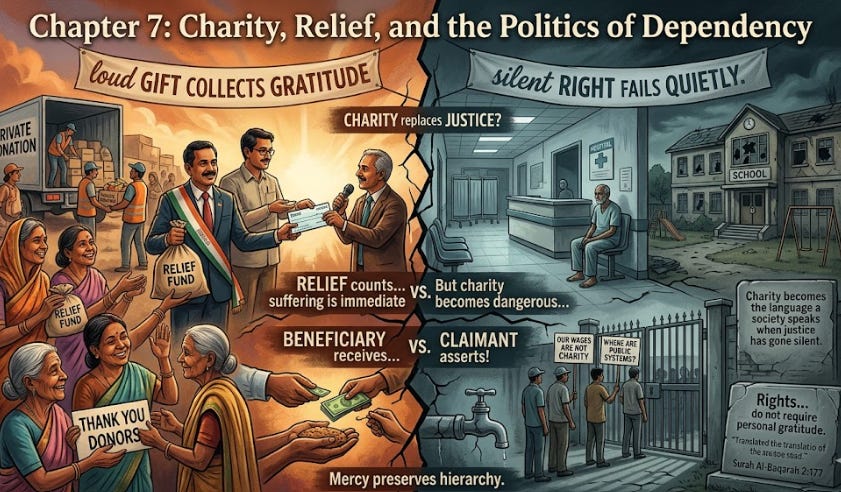
Chapter 7: Charity, Relief, and the Politics of Dependency
A hospital ward runs out of a drug, and a stranger’s donation buys it before the patient’s own government answers for the empty shelf. A right fails quietly, a gift arrives loudly, and the gift collects the gratitude the failed right should have made unnecessary. Charity becomes the language a society speaks when justice has gone silent. It is spoken everywhere public systems break and private mercy rushes to fill the gap.
Pakistan speaks that language fluently, which is why it shows the pattern in high resolution. Charity runs through religious duty, family obligation, political performance, business reputation, disaster response, community survival, and personal morality. A person feeds the hungry. A family pays a hospital bill. A donor builds a school. A foundation funds scholarships. A political figure distributes ration bags. A mosque organizes relief. A business group supports flood victims. A diaspora network sends money for medical treatment. Where public systems fail this often, charity is not merely symbolic. It keeps people alive.
Dismissing charity would be morally unserious. A hungry person needs food before theory. A patient needs medicine before structural analysis. A displaced family needs shelter before policy reform. A widow may need cash before inheritance litigation. A worker whose wages are delayed may need a loan before a labor claim is heard. Relief counts because suffering is immediate. No decent society tells desperate people to wait for institutional reform before receiving help.
Charity becomes dangerous when it replaces justice.
It becomes dangerous when citizens are given food instead of wages, donations instead of public medicine, scholarships instead of functioning schools, relief instead of drainage, favors instead of service guarantees, sympathy instead of property rights, and public praise instead of public accounting. The danger sharpens when the same structures that create suffering then collect moral credit for relieving a small part of it, keeping the poor visible as recipients and invisible as claimants.
A captured order runs this as one of its central tricks. It lets rights fail and then turns partial relief into virtue. A public hospital lacks medicine, so private donors pay for treatment. A school system fails children, so philanthropists sponsor a few students. Workers are underpaid, so employers distribute ration during Ramadan. Women are denied inheritance, so relatives help them with expenses. Public drainage fails, so political actors hand out relief after flooding. Tax collection stays weak, so charity fills gaps the public budget should have closed. The society praises the relief and forgets to ask why the right failed first.
Whether the charitable act is sincere is not the question. Many charitable acts are sincere. The question is whether charity is allowed to become a substitute for public duty. A worker’s wage is not charity. A daughter’s inheritance is not charity. A pension is not charity. Public medicine is not charity. A child’s education is not charity. A police complaint is not charity. A document issued on time is not charity. None of these are gifts from powerful people. They are obligations rooted in law, public finance, contract, religious morality, or citizenship.
A captured society confuses mercy with rights because mercy preserves hierarchy. The giver stands above and is praised, the receiver below and grateful. A transaction like that may relieve pain, but it does not change power. A right works differently. It asks for no personal gratitude. A citizen who receives a birth certificate, medicine, wage, inheritance share, pension, or police acknowledgment is not receiving kindness. He is receiving what is due.
That difference carries weight, because gratitude can silence people while rights can empower them.
The language of “beneficiary” has to be used carefully. Welfare programs may need administrative categories, and the word may be technically convenient. But a society that sees the poor only as beneficiaries will never fully see them as citizens. A beneficiary receives. A claimant asserts. A beneficiary can be selected, excluded, photographed, counted, and thanked. A claimant asks why the system failed, what the rule says, where the record is, and what remedy is owed. The politics of dependency prefers beneficiaries. A republic needs claimants.
Charity also gives elites a powerful form of reputation management. A businessman who avoids tax funds visible philanthropy. A landlord who dominates local tenants sponsors community events. The politician whose networks depend on weak public systems is the one handing out relief. The family that denies women property is still known as generous. The media owner who hides financial influence backs charitable campaigns. The contractor who profits from public opacity donates to religious causes. Charity can throw moral light around people whose wealth, influence, or conduct should still be examined.
This does not make every donor corrupt or every charity suspect. It means charity should not create immunity from accountability. A person may give generously and still owe tax. A family donating publicly still owes inheritance privately. A business funding welfare still owes wages. A politician handing out relief still owes institutional reform. A religious organization serving the poor still owes financial transparency. Charity should add to justice, not replace it. It should never become a moral shield against hisab, the reckoning in which power is made to account for what it did.
Disaster relief shows the problem clearly. Floods, earthquakes, heatwaves, disease outbreaks, and displacement produce real emergencies. Citizens mobilize. Mosques collect funds. Welfare organizations distribute food. Volunteers rescue families. Overseas Pakistanis send money. These responses reveal the society’s capacity for compassion. But repeated disaster relief can also hide repeated governance failure. If drainage corridors are blocked, wetlands filled, rivers encroached, building codes ignored, early warning weak, relief lists manipulated, and reconstruction contracts opaque, then relief becomes only the final visible act in a longer chain of preventable harm.
A flood may be natural. A blocked drain is not. Heavy rain may be climate-related. Illegal construction in water paths is not. Poverty may increase vulnerability. Weak local government makes it worse. Disaster relief is necessary, and disaster accounting is equally necessary. Who allowed the land-use change? Who approved construction? Who maintained drainage? Who received relief contracts? Who was excluded from relief lists? Who audited reconstruction funds? Who profited after the disaster? Without those questions, relief becomes ritual. Citizens suffer, donors respond, politicians appear, cameras arrive, and the same risk rebuilds itself.
Health shows the same pattern. A patient cannot afford treatment, so a donor pays. The act is humane. But the deeper ledger stays open. Why could the public hospital not provide care? Was the medicine budget sufficient? Were medicines procured, delivered, stocked, and issued? Was equipment working? Were patients forced to buy outside? Were private providers profiting from public failure? A charity-funded operation may save one life, and it should not buy silence about the public health chain that left the patient dependent on charity in the first place.
Education follows it too. Scholarships are valuable. Sponsorship can change a child’s life. But a scholarship should not distract from a public school system that fails millions. If the public school does not teach reading, if teachers are unsupported, if classrooms lack basic facilities, if exams reward memorization, if degrees do not build capability, and if poor families must buy private tuition to compensate for state failure, then philanthropy is treating symptoms while the structure holds. A society cannot scholarship its way out of a broken education system. It has to teach at scale.
Charity also shapes politics, because relief creates visibility. A politician who hands out ration bags can look more present than one who quietly fixes a service process. A photograph with food parcels travels faster than a service guarantee. A public donation is easier to show than a corrected record system. A rescue is more emotionally powerful than prevention. The politics of relief rewards spectacle over repair. It teaches citizens to remember the person who arrived after failure, not the institution that should have prevented it.
None of this means relief work should stop. It means relief should be paired with duty. Every relief effort should ask what public failure made relief necessary. Every food distribution should ask about wages, prices, and social protection. Every medical donation should ask about hospital procurement and stock. Every scholarship should ask about public learning. Every disaster response should ask about land use, drainage, planning, and reconstruction accounts. Every ration drive should ask why the household had no stable income. Compassion should open the ledger, not close it.
Religious charity holds a special place here, because it carries moral authority. The obligatory alms and the voluntary gifts and endowments of Muslim practice (zakat, sadaqah, fitrah, waqf) can relieve suffering and strengthen social solidarity. They are part of the moral life of Muslim society. But religious giving must not be used to excuse rights violations. A man cannot deny inheritance and then purify his conscience through donation. The employer who delays wages does not buy back respect through charity. The trader who cheats customers does not cancel the injustice by funding a public meal. The donor who refuses to open his accounts does not erase the gap by invoking piety. Amanah, the duty to hold what is entrusted and answer for it, requires both giving and accounting.
Religious language can either challenge capture or cover it. When religion insists on rights, records, fair dealing, inheritance, wages, trusts, and accountability, it becomes a force against capture. When religion is reduced to visible charity without public accounting, power finds it easier to purchase moral respect. The question is not whether society should give. It should. The question is whether giving is joined to justice.
The captured order prefers charity without accountability, because charity leaves hierarchy intact. The poor stay grateful, the powerful praised, the state under-questioned, the donor visible, the system vague. A recipient receives relief and may gain no voice. Poverty is managed rather than challenged, need softened rather than traced, dependency made humane enough to continue.
A republic needs a different moral sequence.
First, relieve suffering. Then ask why the suffering was predictable, preventable, repeated, or ignored. Feed the hungry, then ask about wages and prices. Treat the patient, then ask about public medicine. Help the widow, then ask about inheritance and pension. Shelter the displaced, then ask about land, drainage, planning, and relief records. Sponsor the student, then ask whether the school teaches. Assist the worker, then ask whether the employer paid. Give compassion immediately, and do not let compassion become an alibi for failed duty.
Captured societies avoid this discipline. They prefer emotion without follow-up, relief without remedy, moral performance without records, poverty treated as an occasion for generosity rather than as evidence of institutional failure. Public accounting applies even in charity. Who collected the funds? Who received them? What criteria were used? What administrative costs were taken? What need was met? What public duty failed? What follow-up was done? What structural remedy was demanded?
This applies to the state as well. Government relief programs may be necessary, and they can also become instruments of political dependency when lists are opaque, eligibility is discretionary, payments are delayed, grievance routes are weak, and beneficiaries are treated as vote banks. A public welfare program should not turn citizens into clients of the ruling party, the local notable, or the administrative gatekeeper. It should run on clear eligibility rules, published budgets, transparent delivery, correction routes, privacy protection, and appeal mechanisms. Public help must be rights-based, not favor-based.
The same test applies to private philanthropy. A foundation that funds schools should show whether children are learning. A hospital charity should show how patients are selected and what outcomes follow. A disaster fund should show its collection, allocation, procurement, delivery, and audit. A religious trust should show its donations and distributions. A diaspora campaign should show who received assistance and how the decisions were made. Transparency does not weaken charity. It protects charity from becoming another site of capture.
The goal is not to drain compassion out of society. It is to stop compassion from being used as a substitute for justice. A society without charity becomes cruel. A society with charity but without rights becomes dependent. A republic needs both mercy and duty, and it has to know which is which. Mercy responds to suffering. Duty stops power from causing, ignoring, or repeating it.
Charity is most honorable when it points beyond itself. The best charity does not ask only, “Who needs help today?” It also asks, “Why did this person need help from a donor for something the law, the budget, the employer, the family, the school, the hospital, or the state already owed?” That second question is where charity becomes dangerous to capture.
A captured order can live with generosity. Generosity that asks for records makes it less comfortable.
This is the line the chapter has to draw. Feed people. Treat people. Shelter people. Support students. Rescue families. Help widows. Assist workers. Fund relief. But do not confuse the relief of suffering with the settlement of justice. A meal does not settle unpaid wages. A donation does not settle stolen inheritance. A scholarship does not settle failed schooling. A medical campaign does not settle public hospital failure. A ration bag does not settle tax injustice. A flood drive does not settle encroached drainage.
Relief answers the wound.
Justice asks who allowed the wound to keep opening.
Until that question is asked, charity can ease pain while dependency survives. The citizen stays thankful, the giver stays praised, and the record stays hidden. No republic runs this way. A society of clients waits for kindness instead.
The work of repair begins when compassion stops ending the conversation and starts opening the file.
Scripture defines righteousness not by the easy outward gesture but by a whole bundle of duties at once, where giving wealth sits beside keeping the pledges you have made. Generosity is one obligation among several, not a payment that cancels the rest.
It is not righteousness that ye turn your faces Towards east or West; but it is righteousness, to believe in Allah and the Last Day, and the Angels, and the Book, and the Messengers; to spend of your substance, out of love for Him, for your kin, for orphans, for the needy, for the wayfarer, for those who ask, and for the ransom of slaves; to be steadfast in prayer, and practice regular charity; to fulfil the contracts which ye have made; and to be firm and patient, in pain (or suffering) and adversity, and throughout all periods of panic. Such are the people of truth, the Allah-fearing.¹
— Surah Al-Baqarah 2:177
Postscript References
The Qur’an, Surah Al-Baqarah 2:177, trans. Abdullah Yusuf Ali, The Holy Qur’an: Text, Translation and Commentary (1938; original edition, public domain).