
Chapter 6: The Language That Hides Power
The Captured Republic

Chapter 6: The Language That Hides Power
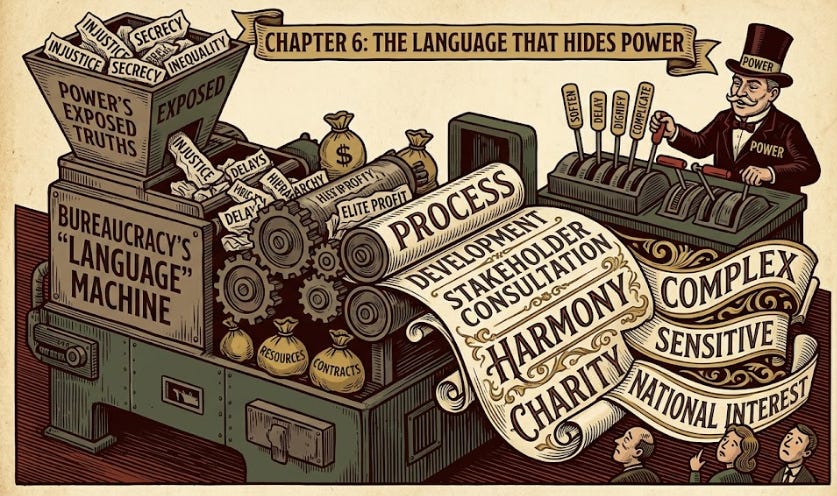
Power rarely speaks plainly when plain speech would expose the arrangement. It softens, delays, dignifies, complicates, redirects. A captured order survives through money, land, offices, contracts, police, courts, and files. It also survives through words. Words teach citizens what to notice, what to ignore, what to fear, what to forgive, and what to treat as too complicated for ordinary judgment. Capture the language and injustice can run for years while sounding reasonable.
Start with the most common hiding word of all. The matter is under process. The file is in process. The committee is processing the issue. The department is following due process. Process belongs in any serious State. A republic cannot decide every claim on the spot, and verification, evidence, and an appeal route are what protect a citizen from arbitrary power. But process can also become a waiting room with no clock on the wall. It delays the decision, buries the person responsible, and exhausts the claimant, all while preserving the appearance of seriousness. The claimant told his case is “under review” hears motion in a word that may only mean stillness. Honest process carries a timeline, a named office, written reasons, an appeal route, and a remedy at the end. Process with none of these is delay wearing better manners.
“Sensitive” works differently. Land records, tax concessions, public contracts, security files, family property, religious finance: each gets the label at some point, and some of it earns the label honestly. Privacy, public order, a claimant’s safety, a genuine commercial secret: these justify careful handling. But sensitivity should shape how something is disclosed, not whether it is. The honest version names what exactly is sensitive, what can be released safely, what must be redacted and why, who reviews the line, and when the file reopens. Sensitivity that explains none of this has stopped being a reason and become a wall.
“Complex” builds the same wall from a different brick. Public finance is complex, land is complex, policing and health systems and federalism are all complex, and often they genuinely are. But complexity is an argument for clearer categories, not for civic silence. If land is complex, then show the parts: title, use, possession, public purpose, litigation, valuation. If health is complex, show procurement, stock, referral, and whether the patient at the back of the queue ever reaches the front. Complexity that produces more documents is accountability. Complexity that produces a shrug is a hiding word.
“Stakeholder” hides a hierarchy inside a circle of chairs. A consultation that calls a developer and a landless resident “stakeholders” in the same breath places them at the same table as if they carried equal weight, when one stands to gain a fortune and the other stands to lose a home. The same flattening dignifies the powerful with the language of inclusion: investors, donors, and large sectors become “stakeholders whose confidence must be preserved,” while the worker, the patient, and the displaced household, stakeholders too by any honest count, are the ones quietly asked to absorb the cost. The serious question is never how many stakeholders were in the room, but which of them held power, which held risk, which held rights, and which were not in the room at all.
“Reform” is the word a captured system reaches for when it wants the credit for change without the change. Governments announce it, departments open cells for it, donors fund it, portals and dashboards get branded with it. None of that is reform. Reform is a changed behavior, an opened record, a guarantee a citizen can hold, a privilege somebody actually lost. If no duty shifted, no record opened, no remedy appeared, and no insider gave up a hidden advantage, the word means only that the old system has learned to speak a newer language.¹
“Development” hides more than any other word because it points at the future, where no one can check it yet. Public land is converted in its name. So are weakened environmental rules, displaced settlements, rezonings that quietly enrich the people who knew the plan in advance. Real development is real. Roads, housing, power, water, schools, hospitals get built and change lives. The word turns into a mask only when it refuses the questions any genuine project can answer: who benefits, who pays, what public asset was spent, what environmental cost follows, who was moved off the land, and what record proves the gain. Development that cannot account for itself is capture with a ribbon-cutting.²
A second family of words works the opposite trick. Instead of inflating power, they shrink a duty into a gift.
“Relief” is necessary when people face hunger, disaster, or sudden crisis, and it saves lives. It turns dangerous the moment it stands in for a right. A ration bag is not the back pay for stolen wages. A donation is not a daughter’s withheld inheritance. A health camp does not explain why the hospital shelf was empty when she needed it. A water tanker is not the water line that should have reached the street years ago. Relief can reduce suffering and should. But it should also open the file on why the suffering was necessary in the first place. When relief becomes the final answer rather than the first one, dependency has quietly replaced citizenship.
“Charity” hides power when it is spent to buy out of a duty. The employer who gives generously in public and underpays in private has not been generous; he has purchased a reputation at his workers’ expense. The family that supports a widow while keeping her share of the estate has not been kind; it has been clever. Charity is genuinely noble, and a republic should honor it. But charity is voluntary, and a right is owed. A captured order prefers charity precisely because charity leaves the giver’s status intact, the hierarchy undisturbed, the gratitude flowing upward. A republic accepts the gift and still asks for the debt.
“Family harmony” is the gentlest of these words and one of the most effective. A woman asks for her inheritance and is told not to disturb the peace. A sister is asked to sign her share away so the property stays whole. A daughter is warned that pressing her claim will break the family. Harmony built on fairness is worth protecting. Harmony that asks the weakest person in the room to pay for it with her silence is not harmony; it is a settlement in which only one side was charged. The honest question is whether the peace survived justice, or was bought with someone’s unpaid claim.
“National interest” is the largest of the hiding words and the hardest to argue with. Security, stability, sovereignty, the continuity of institutions: these are real, and a republic that sneers at them is not serious. But the same phrase can be laid over a contract, a privilege, a failure, or a secret to put it beyond reach. The phrase does not settle the question of whose interest is being served; it only ends the conversation. A republic keeps the conversation open: who defined the interest, what record supports it, what it costs, which citizens pay that cost, and whether a less secret or less harmful path was available. National interest with no accounting behind it is elite interest holding a flag.
Institutions reach for “dignity” when the questions get close. Courts, services, bureaucracies, universities, religious bodies: each can invoke it, and each does need it, because public trust depends on institutions that command respect. But dignity cannot mean immunity from the question. An institution’s standing is strengthened, not threatened, when it can explain its duties, its records, its costs, its errors, and its corrections. Silence is not dignity. Answerability is the real thing: dignity disciplined by the trust it asks the public to extend.
“Merit” hides privilege whenever the contest was unequal before it began. A child wins on merit after a decade of good schools, private tuition, safe housing, fast internet, and the quiet confidence that comes from never having been afraid. Another loses on merit after weak schools, an unsafe street, a slow connection, and no one at home who could guide her through the form. Merit is real and a republic should not abandon standards. But merit measured at the finish line, with no honesty about the staggered start, becomes a polite name for inherited advantage wearing the medal it was always going to win.³
“Efficiency” hides exclusion behind a stopwatch. A system gets faster for the citizen who can use a portal, read the official language, pay the fee, upload the document, and travel to the office, and in the aggregate it looks efficient, because the people it sheds were never counted in the average. The elderly, the rural, the low-literacy, the disabled, the citizen with no smartphone and no broker: the system did not serve them faster, it stopped serving them. Real efficiency reduces friction for the citizen with the least, not the most. An efficiency that makes the State harder for the weak to reach has sorted them out of the queue and called the result speed.⁴
“Modernization” hides procurement and control behind a screen. A government buys software, biometric systems, cameras, dashboards, a database, an algorithm, and calls the purchase progress. Some of it helps. But a new system should answer the old questions: what problem does it solve, who owns the data it collects, how is privacy protected, can a citizen appeal its decisions, can its errors be corrected, and does it shrink the citizen’s dependence on brokers or deepen it. A wall with a touchscreen is still a wall.
Power also hides inside grammar, not just inside words. Mistakes were made. Funds were misused. Land was converted. Files were delayed. Complaints were not processed. Wages went unpaid. Heirs were not recorded. The passive voice is the most efficient hiding place in any language, because it deletes the one thing accountability needs: the actor. A republic restores the subject. Who made the mistake. Who approved the fund. Who converted the land. Which office sat on the file. Which station turned the complaint away. Which employer kept the wages. Accountability begins the moment a sentence is forced to name who acted.
Then there is the technique Orwell anatomized: euphemism, language built to numb the reader before the act can be examined. Eviction becomes clearance. Wage theft becomes adjustment. A bribe becomes facilitation. Favoritism becomes coordination. Surveillance becomes security. An elite bailout becomes stabilization. A flat refusal becomes pending verification.⁵ Each swap lowers the moral temperature of the thing described, so that by the time the citizen reads the word, the harm inside it has cooled past noticing. Public accounting does the reverse. It pulls the plain word back onto the act and lets the reader feel the heat again.
None of this argues for crude speech. Public life needs precision, not insult, and the distinction is the whole point. Some matters really are sensitive. Some delays really are justified. Some confidentiality is necessary, some development real, some charity noble, some reforms genuinely gradual, some institutions unfairly attacked. The danger was never careful language. The danger is language engineered to prevent the careful question, and the cure is not to shout but to translate.
So translate. When power says process, ask for the timeline. When it says sensitive, ask what can be shown safely. When it says development, ask who gained and what public value came back. When it says family harmony, ask whether the rights survived. When it says charity, ask which duty failed first. When it says reform, ask what behavior changed. When it says national interest, ask who pays and who decides. When it says efficiency, ask whether the weakest citizen can still reach the State at all.
Confucius, asked what he would do first if handed a government, answered that he would correct the names. When names are not correct, he said, speech does not accord with reality; when speech loses reality, nothing can be carried through to success. A republic that lets its words drift from its deeds gets government that drifts the same way. Vague words buy vague government; precise questions force power either to answer or to expose its refusal to. The aim is answerability, not rudeness. The republic disciplines its language because the language was always where the capture began.
The Prophet Muhammad ﷺ warned that some would keep the forbidden thing and change only its name: “Some of my people will assuredly drink wine, calling it by another name.”⁶ The wine was still forbidden. The new name was the loophole.
A captured order says, “The matter is sensitive, complex, and under process.”
A republic says, “Name the duty, show the record, give the timeline, write the reason, and identify the remedy.”
Postscript References
Matt Andrews, Lant Pritchett, and Michael Woolcock, Building State Capability: Evidence, Analysis, Action (Oxford: Oxford University Press, 2017), on reform as “isomorphic mimicry,” institutions that adopt the appearance of capable organizations while leaving function unchanged.
James Ferguson, The Anti-Politics Machine: Development, Depoliticization, and Bureaucratic Power in Lesotho (Cambridge: Cambridge University Press, 1990).
Michael J. Sandel, The Tyranny of Merit: What’s Become of the Common Good? (New York: Farrar, Straus and Giroux, 2020).
Pamela Herd and Donald Moynihan, Administrative Burden: Policymaking by Other Means (New York: Russell Sage Foundation, 2018).
George Orwell, “Politics and the English Language,” Horizon, April 1946.
Sunan Abī Dāwūd 3681; also Sunan Ibn Mājah 4020, on the authority of Abū Mālik al-Ashʿarī (may Allah be pleased with him); graded authentic by Ibn Ḥibbān. The closing principle on naming and government draws on Confucius, Analects 13.3 (the rectification of names, zhengming); see The Analects, trans. Edward Slingerland (Indianapolis: Hackett, 2003).