
Chapter 5: How Capture Becomes Normal
The Captured Republic

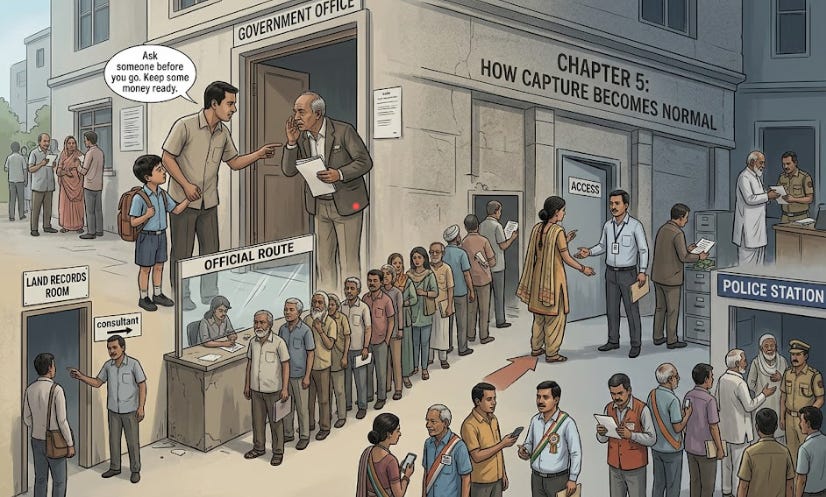
Capture becomes most dangerous when it stops looking like capture. At first, citizens may recognize unfairness clearly. They see the file moved by influence, the tax burden shifted to the visible, the land decision hidden behind development language, the police complaint ignored until a call arrives, the public contract awarded through a process nobody trusts, the worker’s wage delayed, the woman’s inheritance negotiated away, and the hospital patient sent outside to buy medicine. The injury is visible. Anger is real. But over time, repetition changes the moral atmosphere. What once looked intolerable begins to look ordinary.
Normality is capture’s greatest achievement.¹ A captured order does not need every citizen to approve of it. It only needs enough citizens to adapt to it. Adaptation begins as survival. A person learns which office requires a reference, which clerk should be approached, which document may be demanded even if no rule says so, which police station listens to whom, which lawyer knows the route, which agent can interpret the process, which political worker can make a call, which relative can help, which official should not be challenged, which delay should simply be accepted. The citizen does not begin by endorsing injustice. He begins by learning how to live around it.
Abnormal systems become practical knowledge this way. Parents teach children not only values, but navigation. Ask someone before you go. Take an extra copy. Do not argue too much. Find a reference. Keep some money ready. Do not offend the officer. Do not put everything in writing. Wait for the right person. This advice may be protective. It may come from love, fear, and experience. But it also teaches the next generation that the official route is not enough. The child learns early that rights are formal and access is real.
Capture becomes normal when citizens stop asking why a right needs a broker. The presence of the broker becomes ordinary: the agent outside the office, the fixer near the records room, the person who knows someone in the hospital, the lawyer’s clerk who understands the file movement, the local notable who can speak to police, the party worker who can get attention, the relative in government, and the consultant who knows the approval route all become part of the expected system. Their usefulness proves institutional failure, but society often treats them as solutions rather than symptoms.
The same process occurs in public language.² People begin to describe structural abuse as how things work. Files always take time, and a delay becomes normal. Everyone pays something somewhere, so the bribe gets filed under normal too. A recommendation passes as ordinary, since “no one gets anything otherwise.” Loopholes survive because business “needs the adjustment.” Tight cash flow excuses a wage delay. Family property should stay together, the reasoning goes, so a woman’s relinquishment gets called harmony, not loss. Citizens are told they wouldn’t understand the technical matters behind an undisclosed project. A police refusal passes as discretion, because the matter, everyone agrees, is sensitive. Each justification sounds reasonable in isolation. Stacked together, they describe a country that has stopped expecting anything else.
The captured order benefits from this exhaustion of expectation. Citizens may still complain, but their complaints become fatalistic. The system is corrupt, people say, even as they plan around the corruption. Offices are useless, but everyone still searches for access. Politicians are selfish, yet political help gets sought all the same. Courts are slow, citizens know it, and use the delay themselves when it suits them. Taxes are unfair, so people hide what they can. Women have rights, in theory, while family property gets handled quietly. Workers deserve dignity, certainly, though domestic help goes underpaid. The public moral vocabulary remains alive, while daily conduct adjusts to the captured environment.
This split between speech and practice is one of the ways capture reproduces itself.³ A society can condemn corruption loudly while teaching its children how to use influence. Justice gets praised in public and avoided at home, where inheritance fairness goes missing. Labor is honored in speeches; salaries still arrive late. Public service is invoked even as ordinary citizens get treated as interruptions. Religion gets invoked too, while amanah (the trust a person is given to safeguard exactly as entrusted, whether money, testimony, or a promise) is evaded in accounts, wages, testimony, and property. The words remain clean because the practices are renamed as necessity.
Necessity is the most persuasive excuse because it is sometimes true. A poor citizen pays rather than lose a day’s wages. A woman stays silent rather than risk isolation over property. A worker accepts a delayed wage rather than pay more in a legal fight than the wage itself. A small trader stays informal, confused by compliance and afraid of harassment. A parent leans on a school contact when a child’s opportunity is at stake. A patient pays privately because illness will not wait for reform. Survival choices are not morally identical to elite capture.
But necessity can become habit, and habit can become entitlement. A person begins by using a shortcut because the system is hostile. Later he uses it because it is efficient. Later he defends it because everyone does it. Later he resents any reform that would remove his own exception. A victim of capture becomes a participant in capture this way, just at a smaller scale. The original injustice remains real, but adaptation begins to reproduce the same logic.
The small survival compromise of the weak is not the organized privilege of the powerful. A poor family struggling with documents is not the same as a powerful actor bending land policy. The fear keeping a small trader informal is not the network-level capacity that stays hidden behind a major operator. Months of delay before a citizen asks for help look nothing like an elite using access to bypass everyone else. Reform must begin where power is greatest and public cost is largest. But it must also recognize that a republic cannot be rebuilt if every class reserves an exception for itself.
Capture becomes normal through selective memory. Citizens remember the favor that solved their own problem but not the unknown person displaced by it. A file moved through influence may save one family, but another file waits longer. A job arranged by connection may help one household, but a better candidate loses trust. A tax avoided by one group becomes burden elsewhere. A land regularization may benefit one occupant while damaging planning, drainage, or public space. A public contract awarded quietly may enrich a supplier while citizens receive poor service. The immediate beneficiary is visible; the displaced public is often invisible.
This invisibility protects conscience. People tell themselves they are not harming anyone directly. They are only helping their own child, saving time, protecting family, managing risk, preserving business, or adapting to reality. They do not see the public victim because the system hides him. A captured order is built from these hidden injuries. The harm is dispersed across citizens who may never know why their file did not move, why their tax burden increased, why their park disappeared, why their road failed, why their medicine was missing, why their wage claim took too long, or why merit carried no weight at all.
Capture also becomes normal through imitation.⁴ When citizens see powerful people evade rules without consequence, they learn that rules are not moral commitments but obstacles for those without protection. When large violations are regularized, small violators feel foolish for complying. When connected actors receive concessions, honest taxpayers feel punished. When political loyalty brings service, ordinary process feels naive. When women’s property rights are avoided inside respected families, others treat the avoidance as cultural wisdom. When public enterprises lose money without answerability, inefficiency becomes institutional tradition. People imitate the logic that power displays.
This imitation does not always produce wealth. Often it produces smaller forms of evasion. The citizen shut out of land capture can still capture a queue. Shut out of a public contract, the person turns to a relationship that moves a file. Unable to negotiate national tax policy, the business underreports locally instead. The family that cannot move government still finds someone smaller to control: daughters, daughters-in-law, workers, tenants, dependents. Capture at the top creates a moral climate in which capture below becomes easier to justify.
The result is a society where everyone feels both victim and participant. The arrangement is psychologically convenient: it lets each person condemn the system while excusing his own adjustment. The politician points to bureaucracy. Politicians, in turn, get blamed by the bureaucrat. Taxes are the businessman’s excuse; waste is the taxpayer’s. Unfairness gets blamed by the parent who then reaches for a reference anyway. The family blames culture for staying quiet on property. An unfair employer gets blamed by the worker who may go home and mistreat someone weaker. Power gets the blame from media outlets still chasing the incentives that power sets. Every group has a complaint. Fewer groups want their own ledger opened.
Normal capture also depends on politeness. Some wrongs are not confronted because confrontation is considered rude, impractical, disloyal, anti-family, anti-institutional, anti-business, or destabilizing. The woman who asks for inheritance is told not to create conflict. Ask for wage proof, and a worker is told not to be difficult. A citizen who asks for a receipt gets treated as suspicious. A journalist who asks about public advertising gets accused of agenda. Ask about exemptions, and a taxpayer is told the matter is technical. A resident who asks about land conversion is told development requires flexibility. Politeness becomes a discipline imposed on the weaker party.
The language of stability works the same way. Citizens are told that too much questioning will weaken institutions, discourage investment, harm morale, politicize reform, disturb family harmony, or create instability. Some caution is legitimate. Reckless accusation can harm innocent people. Badly designed reform can damage services. Privacy and due process carry weight. But stability cannot mean the continued comfort of those who benefit from silence. The worker without wages is already unstable. So is the woman denied property, the patient buying medicine outside the public system, the resident living with drainage failure, and the citizen whose complaint went unrecorded.
Capture becomes normal when the suffering of ordinary people is treated as background noise and the discomfort of powerful people is treated as crisis. This reversal is one of the clearest signs of a captured moral order. Public questioning of privilege is called dangerous, while private injury caused by privilege is called unfortunate. A republic must restore the correct order. The ordinary citizen’s injury is evidence.
The normalization of capture is also emotional. People become tired of being disappointed, so they protect themselves by lowering expectations. Asking for systems gives way to asking for help. Reform stops being believed in; contacts start being relied on instead. Fairness is no longer demanded so much as inclusion in the unfairness. Public repair goes unimagined while private escape gets planned instead. The captured order does not need to defeat hope in one dramatic act. It wears hope down through repeated proof that the formal route does not work.
Cynicism turns dangerous here. Cynicism often begins as intelligence. People have seen enough lies to distrust promises. But cynicism can become capture’s assistant when it turns every reform into a joke before it begins. It says nothing will change, everyone is corrupt, all records are fake, all reformers have agendas, all institutions protect themselves, and every effort will be captured. Some of this suspicion is earned. But total cynicism relieves the citizen of responsibility. It allows him to feel wise while remaining still.
The answer is modest proof. One office that issues receipts. One hospital that publishes medicine stock. One land process that records female heirs. One ward ledger that tracks complaints. One labor forum that recovers wages. One court category that measures delay. One tax concession ledger that shows cost. One media story that returns after ninety days. Proof does not require citizens to believe everything. It asks them to notice that something can be made answerable.
Public accounting attacks normalization at its root. It interrupts the sentence “this is how things work” with a different question: where is the record? It does not rely on moral shock alone because moral shock fades. It creates a habit of asking for proof. When enough citizens ask for proof repeatedly, normality begins to shift. A missing receipt starts to look strange instead of routine. A missing timeline becomes unacceptable. Written reasons that never arrive start to look suspicious. A public land inventory that doesn’t exist becomes political. Skipping the female-heir safeguard stops being procedural and starts being indefensible. Missing wage proof reads as evidence of exploitation, not paperwork. A story with no follow-up becomes a media failure, not just an old story.
The demand can run upward too, against power itself. One state now treats an official’s unexplained wealth as evidence against him: hold property his known income cannot account for, and the burden falls on him to show where it came from, not on the public to prove the theft.⁵ The record stops being something the citizen begs for and becomes something the powerful owe. The question “where is the record?” is most dangerous to capture when the person who must answer it is the one who benefited.
A recovered republic must make capture feel abnormal again. It must make people uncomfortable with favors that violate rights, shortcuts that injure strangers, charity that hides duty, development that hides land value, reform that hides beneficiaries, family harmony that hides dispossession, and stability that hides public cost. This does not happen through sermons alone. It happens through records, service guarantees, public ledgers, appeal routes, claimant protection, and repeated follow-up.
The citizen must also recover the courage to name what has been renamed. A bribe is not facilitation. A delayed wage is not business difficulty when the worker has already performed the work. A coerced inheritance relinquishment is not family peace. A tax exemption without costed public purpose is not technical policy. A public contract without visible delivery is not development. A police complaint without acknowledgment is not review. A hospital stockout without record is not service. A file under process forever is not administration.
Qur’an 30:41
“Corruption has appeared throughout the land and sea by [reason of] what the hands of people have earned so He may let them taste part of [the consequence of] what they have done that perhaps they will return [to righteousness].”
A captured order says, “This is how things work.”
A republic says, “Then the way things work must be recorded, questioned, and changed.”
Postscript References
Diane Vaughan, The Challenger Launch Decision: Risky Technology, Culture, and Deviance at NASA (Chicago: University of Chicago Press, 1996).
Albert Bandura, “Moral Disengagement in the Perpetration of Inhumanities,” Personality and Social Psychology Review 3, no. 3 (1999): 193–209.
J. P. Olivier de Sardan, “A Moral Economy of Corruption in Africa?” The Journal of Modern African Studies 37, no. 1 (March 1999): 25–52.
Bo Rothstein, The Quality of Government: Corruption, Social Trust, and Inequality in International Perspective (Chicago: University of Chicago Press, 2011), chap. 7, “The Low Trust–Corruption–Inequality Trap.”
On the “unexplained wealth” presumption illustrative of one jurisdiction’s form: Singapore, Prevention of Corruption Act 1960, sec. 24 — pecuniary resources or property disproportionate to a public official’s known income, which he cannot satisfactorily account for, may be treated as corroborating evidence that they were corruptly acquired. The principle is general; the statutory form varies by jurisdiction.