
Chapter 37: Reform Without Consequences
The Captured Republic

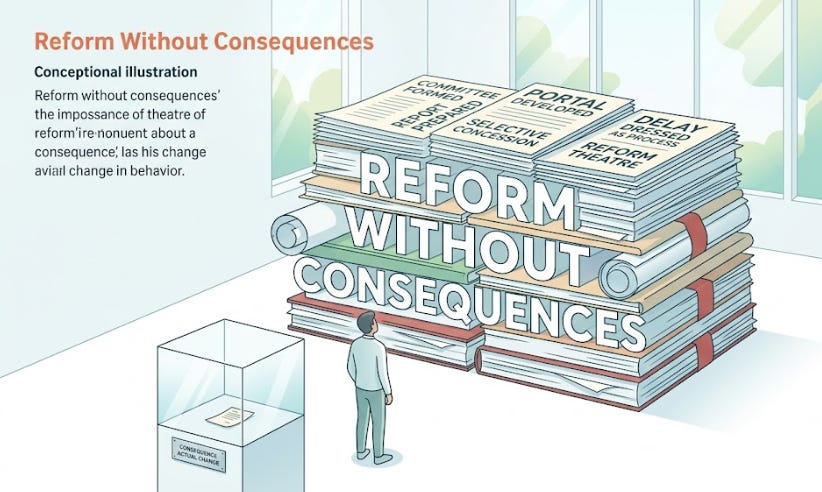
The elite bargain does not disappear when it is named. It adjusts.
Reform movements often fail right after their first moral victory. They expose a pattern, produce outrage, force a statement, create a committee, trigger a suspension, generate a report, secure a promise, win a public admission. For a moment the system looks cornered. But captured systems rarely survive by denying everything forever. They survive by absorbing pressure, redirecting it, narrowing it, delaying it, personalizing it, or converting it into theatre.
This is the second life of the elite bargain. The first life is privilege without answerability. The second is reform without consequence.
Once a demand for accountability becomes too loud to ignore, the captured order adopts the language of reform. Transparency matters. Records will be reviewed. A committee has been formed. A portal is being developed. The matter is under investigation. Guidelines will be issued. The institution takes the issue seriously. Stakeholders will be consulted. A report will be prepared. No one is above the law. The words change before the incentives do.
The reformer has to ask a harder question: what behavior must now change?
If no behavior changes, reform is theatre. If no record proves the change, reform is rhetoric. If no timeline governs the duty, reform is delay. If no consequence follows failure, reform is decoration. If no claimant is protected, reform is unsafe. If no public memory preserves the promise, reform becomes another speech absorbed into the archive of national disappointment.
The elite bargain protects itself first by personalizing reform. It asks who is behind the demand, which party benefits, which institution is being targeted, which ideology is hidden inside the campaign, which donor is funding it, which class is threatened, which foreign interest is involved, which leader is being helped, which rival is being weakened. Some of these questions are legitimate. Movements should be transparent. Funding should be disclosed where appropriate. Reformers should not pretend motives never count.
Personalization becomes a defense mechanism when it replaces the substance of the demand. Regardless of who asks, should public land records be visible? Should tax concessions be costed? Should public contracts disclose beneficial ownership? Should police complaints receive written acknowledgment? Should hospitals publish medicine stock? Should courts measure delay? Should female heirs receive independent notice? Should workers have wage proof? Should welfare exclusions have appeal routes? Should public money show who benefited and who paid?
A captured system wants the debate to stay about the person asking. A republic returns it to the duty being avoided.
The second method is selective concession. The system gives enough to reduce pressure, not enough to change power. It releases a statement but not the data, publishes a summary but not the underlying record, names a junior official but not the approving chain, announces a portal but offers no remedy, promises review but sets no deadline. It makes one example public while keeping the category hidden, lets one case be solved while refusing a rule that would solve future cases by process.
Selective concession works because it creates the appearance of movement. Citizens see something happen and feel the pressure worked. Sometimes it did. Small wins count. But a concession has to be judged by whether it changes the channel of abuse. If one widow receives help but inheritance safeguards stay absent, the system survives. If one hospital is supplied after outrage but stock records stay hidden, the system survives. If one contractor is punished but procurement records stay opaque, the system survives. If one police station is embarrassed but written-complaint rules stay weak, the system survives.
The test is not whether someone responded. The test is whether the next citizen will need less courage.
The third method is delay dressed as process, one of the bargain’s oldest skills. A committee will examine the matter. A department will review the policy. A report will be submitted. A legal opinion will be sought. A pilot will be considered. A stakeholder consultation will be arranged. None of it is a refusal, which is the point. Captured systems use process to consume urgency, keeping the issue alive long enough to appear responsible and slow enough to let public attention fade. Complex problems do sometimes require study. Delay borrows that legitimacy and spends it on time.
Delay is effective because it sounds civilized. It avoids open refusal, lets officials appear reasonable, gives allies something to defend, and exhausts citizens who lack time, money, legal support, media access, or organizational discipline. The captured order does not need to defeat every demand. It needs to outlast most demanders.
Public accounting fights this by attaching every process to a clock. Who is responsible? What is the mandate? What record is being reviewed? What is the deadline? Will the report be public? What interim relief protects claimants? What happens if the deadline is missed? Without those questions, process becomes a padded room where public anger goes to die.
The fourth method is complexity. The captured order calls the matter sensitive, technical, historical, strategic, legal, fiscal, cultural, religious, familial, politically delicate. Sometimes it is right. Land is complex. Tax is complex. Courts, policing, public finance, family property, public-enterprise reform, religious authority, media finance, federalism, security: all complex.
But complexity should raise the quality of reform, not cancel answerability. If a matter is complex, the record is more necessary, not less. Complexity should produce better categories, safer disclosure, phased implementation, claimant protection, privacy safeguards, careful sequencing. It should not become a fog machine. When power calls the matter complicated, the republic answers: then explain the categories, publish the non-sensitive record, name the duty, identify the timeline, and show what cannot be disclosed and why.
The fifth method is the instability warning. Whenever protected privilege is questioned, someone warns that reform may damage the economy, weaken institutions, discourage investment, harm morale, politicize accountability, threaten family harmony, disturb religious sentiment, compromise security, destabilize democracy. Some of this is real. Reckless reform can harm people. Institutions can be weakened by irresponsible attacks. Privacy can be violated, due process ignored, markets damaged by crude policy. Families can become unsafe for vulnerable claimants when reform lacks protection.
But instability cannot become a permanent veto. The existing order is already unstable for ordinary citizens. A worker waiting for wages lives with instability. A woman pushed out of inheritance lives with instability. A patient buying public medicine outside the hospital lives with instability. A student stalled at a records office lives with instability. A taxpayer carrying visible burdens while hidden privilege survives lives with instability. A young person planning exit because the country feels unrepairable lives with instability.
The elite bargain calls its own comfort stability and the citizen’s demand disruption. A republic rejects that moral reversal.
The sixth method is data control. A captured system speaks of transparency while controlling the data that counts. It publishes documents in unusable formats, releases partial numbers without definitions, provides dashboards without remedies, discloses totals without beneficiaries, shows budgets without payments, lists projects without contractors, announces procurement without ownership, publishes policies without performance, produces reports without raw categories. It floods the public with information while withholding the record that would establish responsibility.
This is transparency as performance. The citizen is given enough paper to feel informed, not enough structure to hold anyone accountable.
Real transparency is usable. It tells citizens what was owed, who owed it, who received public value, who paid public cost, what timeline applied, what reason was given, what remedy exists, and what changed after the issue was raised. A thousand pages that answer none of those questions are less transparent than a one-page ledger that answers them.
The seventh method is consultation without transfer of power. The captured order invites stakeholders, holds sessions, records comments, thanks participants, and proceeds as before. The form of listening is complete; only the consequence is missing. Real consultation improves design, reveals risks, protects vulnerable groups, builds legitimacy. This kind becomes theatre when the agenda is predetermined, the data withheld, dissent managed, affected citizens absent, and the final decision never explains how public input changed the outcome.
The question after consultation should be simple: what changed because citizens were heard?
If the answer is nothing, the consultation was decoration.
The eighth method is selective enforcement. The system acts against some violations while leaving comparable ones untouched. It removes small encroachments while negotiating large ones, pursues small defaulters while restructuring powerful obligations, disciplines weak officials while protecting decision-makers, punishes one employer while leaving wage-theft patterns intact, exposes one scandal while hiding the category. Selective enforcement lets power claim seriousness while preserving discretion.
A serious republic insists on categories. Not one encroachment, but a land inventory. Not one tax offender, but a tax-expenditure ledger and enforcement map. Not one delayed court case, but case-age data by category. Not one hospital scandal, but medicine-stock disclosure. Not one inheritance dispute, but safeguards for every female heir. Not one unpaid worker, but wage proof and recovery mechanisms. The category is what the bargain fears, because the category exposes the pattern.
The ninth method is moral substitution. Power offers charity instead of rights, patriotism instead of accounting, tradition instead of inheritance, reform language instead of disclosure, national interest instead of public record, institutional dignity instead of answerability, sympathy instead of remedy. The words are noble. That is why they work. A captured order rarely defends itself by saying it prefers privilege. It says it is protecting stability, development, faith, family, growth, investment, morale, unity.
A republic does not need to reject noble words. It needs to ask whether those words are being used to avoid duty. If a policy serves development, show the public value. If a concession protects growth, show the cost and the benefit. If a tradition protects family, show that it does not erase rights. If institutional dignity counts, show that dignity includes answering the citizen. If patriotism requires sacrifice, show that the sacrifice is shared.
The tenth method is scale paralysis. The bargain makes reform feel too large to begin. Land, tax, courts, police, schools, hospitals, labor, media, local government, public enterprises, religion, diaspora, family, bureaucracy: all connected. The citizen sees the whole system and feels defeated. The captured order benefits from that feeling. It wants reform to look either total or useless. If the whole republic cannot be fixed at once, people retreat into cynicism, private escape, or savior politics.
Sequence is the answer. A system does not have to be attacked everywhere at once. Start where records can be opened, where public harm is visible, where early wins can teach method, where coalitions are possible, where the weakest claimants can be protected, where the first ledger makes the next ledger easier. A captured order is large, but every hidden privilege needs a hiding place. Remove the hiding places one by one.
The eleventh method is cynicism. The bargain tells citizens nothing will change: every reformer is corrupt, every movement is funded, every official is compromised, every party is the same, every institution protects itself, every citizen is selfish, every slogan is fake, every attempt will be captured. The trap is that much of it is earned. People have seen enough betrayal to distrust any promise. Cynicism dressed as wisdom is still surrender. It lets the citizen feel intelligent while doing nothing.
The answer is modest proof. Do not promise national salvation in one stroke. Prove one service can be tracked. Prove one hospital can publish medicine stock. Prove one ward can display projects. Prove one land office can notify female heirs. Prove one labor forum can recover wages. Prove one court category can reduce delay. Proof weakens cynicism more than rhetoric does. The public does not need to believe everything can change before something changes. It needs repeated evidence that the method works.
The twelfth method is capture of the reform language itself. Once public accounting becomes attractive, power imitates it. It builds fake dashboards, weak scorecards, cosmetic audits, selective ledgers, controlled complaint systems, public reports that hide more than they reveal. It uses the vocabulary of answerability while preserving the old discretion. Every serious reform language eventually attracts counterfeit versions.
The protection against counterfeit reform is audit. Who controls the data? Can citizens verify it? Are definitions clear? Are vulnerable claimants protected? Are refusals recorded? Are timelines measured? Are appeals real? Are consequences visible? Can independent actors compare official claims against citizen experience? Is the record useful to the unknown citizen, or only impressive to donors, officials, and conferences?
A dashboard is not a republic. A portal is not a remedy. A report is not accountability. A committee is not reform. A slogan is not public accounting.
The elite bargain’s weakness is that it cannot easily defend hidden privilege in plain language. Few beneficiaries will say, “We deserve exemption without disclosure.” They say the matter is sensitive, strategic, historical, technical, stabilizing, traditional, developmental, misunderstood. The reformer’s task is to respect real complexity while refusing protective fog. Serious reform does not need reckless accusations. It needs disciplined questions.
Which land? Which concession? Which contract? Which donor? Which guarantee? Which delay? Which exemption? Which share? Which wage? Which office? Which record?
Those questions are harder to defeat because they do not depend on hatred of elites. They depend on the principle that public power must answer. A recovered republic does not need to destroy every elite. It needs to change the terms under which elites operate. Wealth justifies itself through fair contribution. Political power discloses its financing. Religious authority answers to moral consistency. Media influence reveals its financial dependency. Bureaucratic discretion leaves records. Judicial authority confronts delay. Business privilege proves public value. Institutional autonomy coexists with public accountability. Family authority stops at the boundary of rights. Security protects the republic without replacing it.
This is not anti-elite. It is anti-impunity.
The public response has to be as cross-cutting as the bargain itself. Citizens, lawyers, journalists, teachers, doctors, religious leaders, civil servants, judges, workers, women, students, business owners, diaspora professionals, resident groups, and local communities each ask related questions in their own domains. Not the same slogans. The same discipline: duty, record, timeline, reason, remedy, answerability.
The visible disorder will continue. There will still be elections, scandals, court cases, media storms, economic crises, institutional tensions, public arguments. The deeper work is to stop confusing noise with repair. Elites can fight one another while preserving the bargain. Reform begins when citizens ask which privileges stay untouched while the fight goes on.
Every method in this chapter runs on the same move: the words of reform arrive and the conduct does not follow. Scripture names that gap and weighs it. “O you who have believed, why do you say what you do not do? Greatly hateful is it in the sight of Allah that you say what you do not do.”
A captured order says, “This is sensitive, complex, and being handled.”
A republic says, “Then publish the record, name the duty, set the deadline, and show the result.”