
Chapter 21: Education Without Capability
The Captured Republic

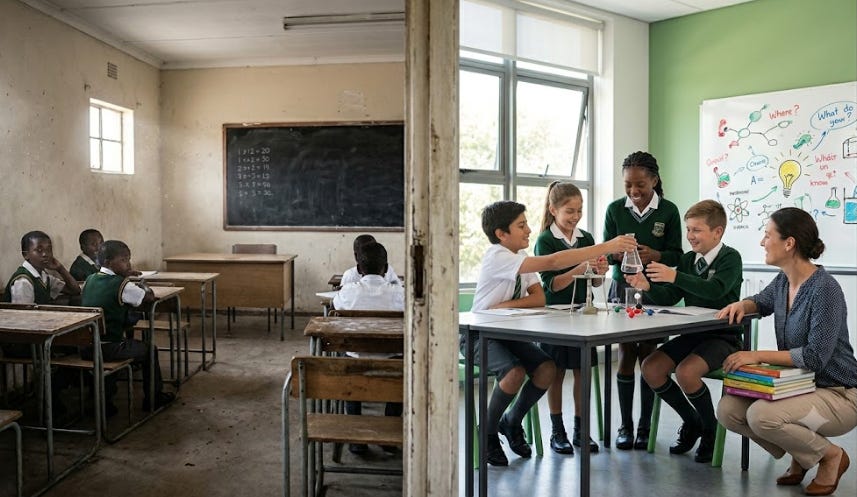
Education is the one promise everyone in public life agrees to make. Governments praise it, parents sacrifice for it, parties pledge it, reform speeches invoke it, and every society tells its children it is the path out of poverty, dependency, and humiliation. In a functioning republic that promise has meaning, because schooling creates capability. It teaches a child to read, write, calculate, reason, communicate, question, build, work, and take part in public life. It gives the poor a route into citizenship that does not run through family name, land, patronage, or private influence.
Education without capability becomes another form of capture. A society can report that children are enrolled when they are not learning, that schools have opened when no one is being taught, that degrees have multiplied when competence has not. Parents spend beyond their means and receive no real formation. Universities issue credentials while employers complain about skill. Governments announce buildings, tablets, scholarships, laptops, and enrollment numbers, and the harder question goes unasked: can the student actually do what education promised?
The difference between schooling and capability runs through everything that follows. Schooling is attendance, buildings, uniforms, timetables, exams, fees, certificates, degrees. Capability is what remains inside the person after the system has finished with him. Can he read a passage and explain it, write a clear paragraph, calculate accurately, solve a problem that was not copied off the board? Can he ask a question, use evidence, learn a tool, work with others? Can he make sense of a form, a contract, a wage slip, a medicine label, a land record, or a tax notice? A republic does not need education as decoration. It needs education that makes citizens harder to cheat.
Weak education helps capture survive. A citizen who cannot read the rule depends on whoever interprets it. A worker who cannot preserve wage proof is easier to deny. A woman who cannot read inheritance documents is easier to pressure. A patient who cannot follow a medicine record is easier to push toward a private purchase. A taxpayer who cannot read a notice is easier to frighten, a voter who cannot compare claims easier to manipulate. A young person without usable skill becomes a client of parties, patrons, recruiters, relatives, or foreign labor markets.
Education is not only a social sector. It carries a power question.
The captured order is comfortable with education that produces aspiration without capability. A child is told to dream while the school does not teach him to think. A family pays fees while the institution sells status. A university hands out degrees while its graduates cannot solve problems. A training program counts its certificates as success. A government counts rising enrollment as progress. A donor counts delivered inputs as impact. The ledger looks busy. Its citizen stays weak.
Public education carries the highest moral burden, because it is the poor child’s main route into the republic. When public schools fail, the poor do not simply receive a weaker service. They lose time that cannot be recovered. Childhood passes once. A child who spends years in school without reading fluency, numeracy, reasoning, language confidence, and basic civic understanding has not merely been underserved; his future bargaining power has been cut. He can be formally educated and practically dependent, holding a certificate and still unable to escape low-wage work, understand public systems, or claim his rights.
Private education does not solve this. It builds exits for some families and anxiety for many more. Some private schools teach well and are serious institutions, and many parents turn to them because they cannot wait for public repair. That choice is understandable. But once private schooling becomes the middle class’s main survival strategy, public education loses its most powerful constituency for reform. Public schools become schools for other people’s children. The poor stay inside the failing system while those with voice buy their way out.
Private schools carry their own accounting questions. A school that charges fees should be able to show learning, teacher quality, safety, transparency, and fair treatment. A brand name proves nothing. English-medium signage proves nothing. High fees prove nothing. A school can sell confidence, class identity, exam coaching, parental reassurance, and foreign aspiration while doing too little to build deep reading, reasoning, writing, scientific thinking, civic responsibility, and practical skill. Education capture is not confined to government schools. It appears wherever credentials, status, and parental fear are sold without honest learning.
Examination systems can deepen the damage. When exams reward memorization, coaching, guessing, and narrow repetition, schools teach toward those habits, and students learn to pass without learning to think. Teachers are pressured to finish syllabi rather than build understanding. Parents judge success by marks, because marks are the visible currency of the system. Universities admit by scores that do not measure capability. Then employers complain that graduates cannot write, analyze, communicate, or solve problems. The system manufactures evidence of progress while quietly weakening the person.
A recovered education system measures learning directly. Enrollment, attendance, infrastructure, and teacher presence each count for something and none of them answers the central question: are children learning? Reading, writing, numeracy, reasoning, scientific understanding, language ability, digital competence, and civic literacy should be measured in ways that are honest, age-appropriate, and resistant to manipulation. These measures are not built to punish schools. They show where help, training, resources, leadership, and redesign are needed.
Teacher dignity holds the whole thing up. No society repairs education by humiliating teachers. Many work in overcrowded classrooms with weak training, political interference, low morale, poor materials, unsafe facilities, and heavy administrative loads. Some are dedicated and under-supported; some are absent, underprepared, or disengaged. The system has to tell these apart. Good teachers should be supported, trained, protected, and recognized; chronic failure should be addressed. Accountability has to be paired with capacity, because a classroom cannot be fixed by blame alone.
School leadership decides the rest. A principal who tracks attendance, supports teachers, reviews learning, engages parents, protects girls, manages facilities, and reports problems honestly can turn a school around. But principals need authority, training, data, and protection from political pressure. When postings, transfers, procurement, teacher attendance, and repairs are controlled by forces outside the school, local leadership is only symbolic. Reform has to connect responsibility with authority.
The public accounting approach to education begins with a learning ledger. For each school or district, citizens should be able to see the basic facts: enrollment, attendance, teacher presence, facility status, textbook availability, learning levels, student progression, dropout patterns, gender gaps, disability access, complaint routes, budget, and repair needs. The data should be simple enough for a parent to read and strong enough for an administrator to act on. A school ledger is not another decorative dashboard. It exists so citizens can ask whether the school is actually teaching.
The ledger has to count the children who disappear from it. A dropout is not a statistic. It usually carries a story of poverty, distance, danger, child labor, early marriage, disability, language exclusion, bad teaching, parental despair, or a school that felt irrelevant. A child who leaves is not just absent from a classroom; he may be entering low-wage labor, household work, street vulnerability, dependency, or permanent exclusion from skilled work. A republic should know which children leave, when, why, and what route brings them back.
Girls’ education has to be discussed past the enrollment figure. A girl can attend school and still lack safety, transport, sanitation, family support, learning quality, digital access, or permission to use her education economically. She can be praised for studying and still denied inheritance later, educated enough to contribute but not empowered enough to own property or claim her rights. Her education has to be tied to safety, property rights, health, work, mobility, and legal awareness. Otherwise the system celebrates the girl in the classroom and leaves her exposed in the family ledger.
Universities need their own accounting. A university is not measured by its count of graduates, degrees, departments, conferences, publications, buildings, or rankings. It earns its measure on capability, research integrity, employability, civic contribution, problem-solving, industry connection, and whether its graduates can think clearly. A degree that creates no usable competence is a delayed fraud against the student and the family that paid for it. Universities should publish program outcomes, graduate capabilities, employment pathways, research standards, student support, transcript timelines, complaint routes, and employer feedback where it can be responsibly collected.
Technical and vocational education needs the same honesty. Training programs announce large numbers, and the real question is whether the trainee gains marketable skill, earns a certificate employers respect, finds work, starts a viable enterprise, or raises his income. A sewing, computer, electrical, language, or artificial-intelligence certificate is worth little if no capability sits behind it. Training without placement, tools, practice, assessment, and follow-up is one more ritual of development.
Education is where civic claimant training should begin. Students should learn to read public notices, preserve documents, ask for receipts, understand their rights, tell allegation from evidence, file basic complaints, track deadlines, read budgets, and use public information responsibly. Civic education is not a set of patriotic slogans. A citizen has to know how to stand before the State without kneeling. Schools should teach the language of duty, record, timeline, reason, appeal, and remedy.
Technology supports education; it does not replace learning. Tablets, portals, online classes, digital attendance, learning apps, and artificial-intelligence tools help when they are designed around teachers, students, language, access, and assessment. They also turn into procurement theatre. A device is not education. A dashboard is not learning. A platform students cannot use, teachers cannot integrate, and parents cannot understand is not reform. The test of education technology is simple: do students learn more, do teachers teach better, does accountability improve?
A companion set of tools for this chapter is available at https://thecapturedrepublic.org/appendix/k-education-ledger.html: a school learning-ledger template, a dropout-tracking sheet, a girls’-education checklist that runs past enrollment, and a graduate-capability scorecard for universities and training programs.
The recovered republic has to stop asking only how many children are in school and start asking what school has placed inside them. It has to stop treating certificates as proof of capability and buildings as proof of learning. It has to stop letting public schools fail the poor while private schools sell escape to the anxious. It has to stop producing graduates who know how to pass and not how to think, write, build, question, or work.
A time would come, the Prophet Muhammad ﷺ said, when knowledge disappears. Ziyad ibn Labid asked how knowledge could disappear when they recited the Qur’an and would teach it to their children and their children after them. The Prophet ﷺ answered that the Jews and Christians had the Torah and the Gospel in their hands, yet drew no benefit from them.¹
A captured order says, “The child is enrolled.”
A republic says, “Can the child read, write, calculate, reason, and claim his place in public life?”
Postscript References
Ziyad ibn Labid al-Ansari (may Allah be pleased with him) reported that the Prophet Muhammad ﷺ spoke of a time when knowledge would be taken from people, and when Ziyad asked how that could happen while they recited the Qur’an and taught it to their children, the Prophet ﷺ replied that the Jews and Christians possessed the Torah and the Gospel yet did not benefit from them. Jami’ al-Tirmidhi 2653 (Book of Knowledge), graded hasan gharib by al-Tirmidhi; also Sunan Ibn Majah 4048, graded authentic by corroborating evidence. The point of the closing element: possessing and reciting a text is not knowledge if no capability or action follows from it. This is the founding tradition’s name for schooling that leaves nothing inside the person. On the closing-element selection and the full candidate field considered, see the internal closing-element audit (not for publication).