
Chapter 2: The Republic That Works for Some
The Captured Republic

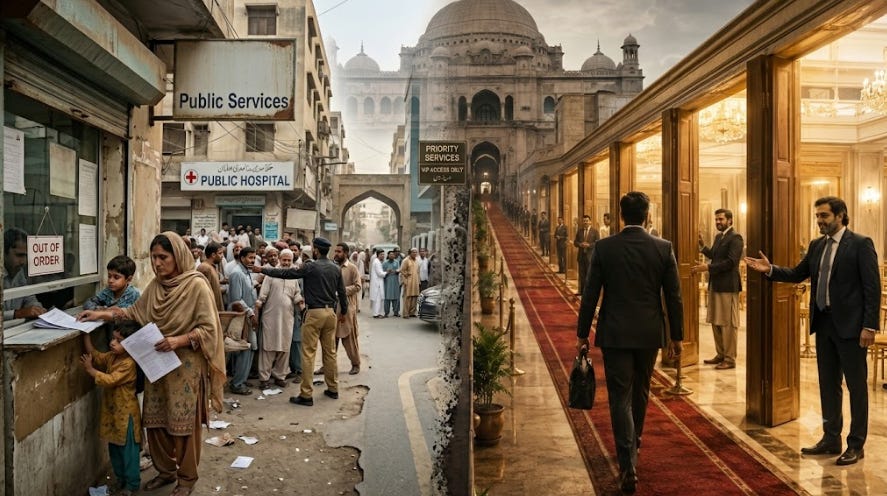
Chapter 2: The Republic That Works for Some
A country can fail its citizens without failing everyone equally. This is one of the hardest truths to admit because national language prefers unity. We speak of the economy, the State, the people, the crisis, the system, the nation, and the public as if everyone experiences the same country. These words are necessary, but they can also hide the unevenness of life. The same office that delays one file may move another in a day. The same police station that discourages one complaint may respond immediately to a connected call. The same tax system that reaches the salaried worker automatically may negotiate endlessly with larger sources of wealth. The same court delay that destroys a widow’s claim may protect a powerful defendant. The same land system that confuses an ordinary family may enrich someone who understands how to move through ambiguity.
The republic does not fail in one uniform way. It works selectively. For some people, Pakistan is a negotiable country. Its laws can be managed. Its procedures can be accelerated. Its offices can be accessed. Its officers can be reached. Its politics can be influenced. Its courts can be delayed or activated. Its taxes can be arranged. Its land can be converted. Its contracts can be obtained. Its public money can be approached. Its media can be shaped. Its religious spaces can be patronized. Its public language can be used to defend private advantage.
For others, Pakistan is exhausting. It asks for documents, visits, signatures, payments, patience, silence, compromise, and endurance. It tells them to come back tomorrow. It tells them the officer is not available. It tells them the file is under process. It tells them the case will take time. It tells them the medicine is not available. It tells them the school is functioning even when the child cannot read. It tells them the police will look into it. It tells them the land matter is complicated. It tells them the pension is pending. It tells them the complaint has been received. It tells them everything except a clear answer.
This is the republic that works for some. The phrase is a practical description. A system can be inefficient in general but efficient for the connected. It can appear chaotic from the outside and highly navigable from the inside. It can produce poor outcomes for the majority while still delivering valuable outcomes to organized groups. A captured order does not need to destroy institutions. It only needs to make them selectively available.
Selective availability is more stable than open rule by privilege because it preserves the language of equality. Courts stay open to everyone. Offices accept applications from everyone. Hospitals treat the public. Schools enroll children. Tax law applies generally. Police stations carry a legal duty. Land offices maintain records. Procurement rules require competition. The constitution declares rights. Formally, the republic belongs to all. Operationally, access differs.
This difference shapes the psychology of citizenship. Connected citizens learn confidence. Ordinary citizens learn caution. Poor citizens learn fear. Middle-class citizens learn workaround. Elite citizens learn entitlement. Overseas citizens learn anxiety about property and paperwork. Young citizens learn exit. Women learn that legal rights may still require family permission to become real. Workers learn that earned wages may require pleading. Patients learn that public care may still require private money. Taxpayers learn that honesty does not guarantee fairness.
A republic cannot survive indefinitely when different classes learn different meanings of the State. For the connected, the State is a tool. For the weak, it is a maze. For the poor, it can be a threat. For the middle class, it is both burden and resource. For the elite, it is often a platform: a source of contracts, licenses, visibility, protection, influence, land value, subsidy, regulation, exemption, and prestige. These experiences create different political expectations. A person served by access does not feel the urgency of institutional reform. One trapped without access may want reform, but also needs immediate help. The patron enters the space between right and reality.
The republic that works for some produces two forms of legitimacy. Public legitimacy comes from elections, laws, courts, flags, speeches, ceremonies, and official documents. Private legitimacy comes from usefulness to those who know how to operate the system.¹ If powerful groups can use the State, they may tolerate its broader dysfunction. A tax system that cannot fund schools may still protect their wealth. A court system that delays justice may still protect their property. A police system that frightens the poor may still protect their neighborhoods. A public education system that fails the majority may not disturb them if their own children attend elite schools. A public health system without medicines may not reach them if they use private hospitals. A city without drainage may not reach them if their enclave is protected. A passport office that frustrates ordinary people may not reach them if they can get assistance. Dysfunction is bearable when one has exits.
This is why private escape is politically dangerous. It does not merely solve one family’s problem. It weakens shared pressure to repair common systems.² Elites escape through foreign schools, private hospitals, gated housing, generators, guards, drivers, legal teams, foreign passports, offshore assets, and direct access. The middle class escapes partially through private education, private clinics, solar panels, tuition centers, agents, personal contacts, and migration planning. Poor citizens cannot escape the same way. They depend on the broken public system or the local patron. The more private escape expands, the more the republic becomes residual. It remains for those who cannot leave it.
This creates a cruel inversion. Citizens most dependent on public institutions are often the least powerful in shaping them. Citizens most able to shape institutions are often the least dependent on them. The poor need public schools, public hospitals, police protection, local government, welfare, and courts. But they have weak voice. Elites have voice, money, and influence, but they can buy alternatives. The result is a republic whose repair is least urgent to those most capable of forcing repair.
This is why the language of national sacrifice often sounds hollow. Citizens are asked to pay more, wait longer, tolerate inflation, support stability, accept austerity, and believe in reform. But they can see that sacrifice is not distributed equally. Some sacrifice consumption. Some sacrifice opportunity. Some sacrifice dignity. Some sacrifice time. Some sacrifice family separation through migration. Some sacrifice the future itself. Meanwhile, certain groups sacrifice little and explain much.
A republic that works for some always develops an explanation industry. It produces reasons why privilege cannot be touched.³ Tax reform must be gradual. Land questions are sensitive. Public enterprise reform is complicated. Judicial delay must respect process. Police reform must consider morale. Media transparency may threaten freedom. Religious finance is delicate. Political finance is difficult. Elite perks are symbolic, not substantial. Public procurement cannot disclose too much. Subsidies protect jobs. Amnesties encourage compliance. Regularization is pragmatic. Each explanation may contain a piece of truth. Together, they become a wall.
The citizen is told the country cannot move too fast. But the same country can move very fast for those with access. A poor family’s encroachment can be removed in the name of law, while elite land violations remain under litigation, negotiation, or regularization. A small consumer’s utility connection can be cut for non-payment, while large defaulters receive restructuring. A salaried worker’s tax is deducted before income reaches him, while larger undocumented flows remain difficult to touch. A worker can be fired quickly, but wage recovery can take time. A student can miss an application deadline because of a delayed transcript, while an influential file can receive urgent treatment. A poor accused person can remain trapped in process, while a powerful accused person uses process as shelter.
Not every powerful person wins, and not every poor person loses. What repeats is pattern. When the pattern repeats across institutions, citizens learn that equality before law is less reliable than proximity to power. Cynicism grows from that pattern. Cynicism is often a rational response to repeated unequal experience.⁴ When people see that rules are selectively enforced, they stop respecting rules as moral standards. They begin to see rules as obstacles for the weak and instruments for the powerful. Some then seek their own exception. Others withdraw. Others leave. Others rage. Others become clients. Others become predators at smaller scale. The republic loses moral authority.
A State can enforce through fear after losing moral authority, but it cannot build deep trust that way. Trust requires citizens to believe that compliance will not make them fools. Taxpayers must believe evaders will not be rewarded. Builders who follow rules must believe violators will not be regularized cheaply. Women claiming inheritance must believe law will protect them before family pressure destroys their claim. Workers must believe wage law can be enforced before hunger forces compromise. Students must believe procedure is real before they start looking for shortcuts. Business owners must believe connected competitors will not win through bribery or influence. Citizens must believe waiting in line is not stupidity.
The republic that works for some destroys this belief. Its most damaging effect is educational, not merely economic. Children see parents using contacts. Students see degrees without capability. Workers see employers delay wages without consequence. Daughters see inheritance negotiated away. Young men see political workers get access. Patients are forced to buy medicine outside. Citizens see project boards missing. Viewers see media narratives shift with interests. Voters see parties funded by invisible money. The lesson becomes practical: do not rely on the rule if you can find a route around it.
A society cannot teach civic virtue while rewarding civic evasion. This is why reform cannot be limited to punishing spectacular corruption. Spectacular corruption counts, but the daily republic is shaped by ordinary unequal access. The citizen is less likely to encounter a billion-rupee scandal directly than a service counter, school, hospital, police station, land office, employer, court date, utility office, or local government project. If these remain unequal, the republic remains captured even if a few famous people are punished.
The reform question is therefore not only, “Who stole money?” It is also: who had to wait, who was moved forward, who received reasons, who received silence, who paid unofficially, who used influence, who was excluded, who was protected, and who could not even enter the record? A republic that works for all must account for ordinary access, not only spectacular theft.
This accounting must be practical. Every service should have a responsible office, requirement list, official fee, receipt, timeline, written reason, appeal, and remedy. Every public project should have a board, contractor, cost, timeline, and completion record. Every tax privilege should have a cost and beneficiary category. Every hospital should show stock. Every court system should measure delay. Every police station should acknowledge complaints. Every land office should protect heirs. Every school should measure learning. These are how the republic stops working only for some.
The recovered republic must make selective access harder to hide. It must reduce the value of personal influence by strengthening the ordinary route. It must make the unknown citizen visible. It must make the connected citizen less necessary as proof that the system can work. It must make public service boring, predictable, and traceable. The goal is not equal wealth, status, or outcome, but ordinary rights that no longer depend on private access.
A captured order says, “The system works if you know how to navigate it.”
A republic says, “The system must work for the citizen who knows no one.”
And O my people, give full measure and weight in justice and do not deprive the people of their due and do not commit abuse on the earth, spreading corruption. — Qur’an 11:85
Postscript References
Douglass C. North, John Joseph Wallis, and Barry R. Weingast, Violence and Social Orders: A Conceptual Framework for Interpreting Recorded Human History (Cambridge: Cambridge University Press, 2009). Their “limited access order” describes this split: institutions that formally serve everyone while a dominant coalition extracts the real value, the order’s stability resting on elites being able to use the state even as it fails everyone else.
Albert O. Hirschman, Exit, Voice, and Loyalty: Responses to Decline in Firms, Organizations, and States (Cambridge, MA: Harvard University Press, 1970). Hirschman treats exit and voice as substitutes — when those most able to leave a failing system do so, the pressure for reform their voice would have supplied leaves with them.
Albert O. Hirschman, The Rhetoric of Reaction: Perversity, Futility, Jeopardy (Cambridge, MA: The Belknap Press of Harvard University Press, 1991). Hirschman catalogued the recurring arguments against reform — that it will backfire, change nothing, or endanger something already won — the machinery the chapter’s “explanation industry” runs on.
Tom R. Tyler, Why People Obey the Law, rev. ed. (Princeton, NJ: Princeton University Press, 2006). Tyler’s procedural-justice research found that legal compliance tracks perceived fairness of treatment more closely than fear of punishment; repeated unequal treatment makes withdrawn respect for the rule the predictable response, not an aberration.