
Chapter 14: Procurement: Where Policy Becomes Profit
The Captured Republic

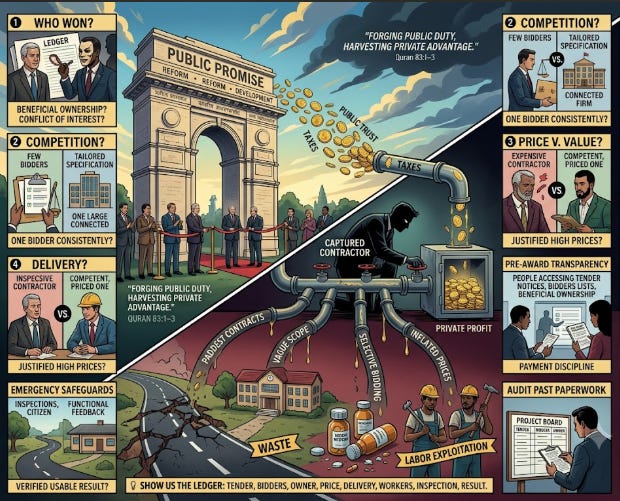
The road was announced, the ribbon was cut, and within two monsoons the surface had broken apart. The speech promised development; the contract delivered a channel. Procurement is the point where a public promise becomes private revenue, the moment someone is selected to deliver it, paid to perform it, and supposedly held to account for the result.
This is why procurement is one of the most important ledgers of capture. A government can speak beautifully about reform while contracts quietly move value into protected hands. The public hears about a project but never sees the tender design, bidder list, evaluation criteria, beneficial ownership, variation orders, payment schedule, inspection record, completion certificate, worker payment, maintenance obligation, or complaints. A project can live in the public imagination as development while the procurement file tells a different story.
Procurement is not corrupt by nature. Governments must buy goods, build infrastructure, hire services, procure medicine, and respond to emergencies. Private contractors, suppliers, and engineers are necessary to public delivery. A serious republic needs professional procurement. Capture begins when the process is designed or obscured so that private advantage outruns public value.
The first question is what was bought. Many failures begin with vague scope. A contract for a road, hospital equipment, school furniture, or medicine supply must define its required output clearly enough for delivery to be verified. Vague scope makes performance negotiable. Specifications written for a preferred supplier turn the contest into a formality. When quantities, standards, and timelines are unclear, citizens cannot know whether the public received what it paid for.
Second, who won. The name of the winning bidder is not enough. Citizens and oversight bodies need to know who owns or controls the winning entity where law permits disclosure, whether related parties are involved, whether the bidder has performed similar work, and whether it has the capacity to deliver. Beneficial ownership counts because companies hide real control behind layers. A republic cannot prevent conflict of interest if it cannot see who stands behind the contract.
Third, who else bid. Competition is what makes a tender meaningful. One bidder appearing repeatedly, conditions that exclude most competitors, specifications that appear tailored, deadlines too short to meet, losing bidders consistently failing for minor reasons while connected firms succeed: each deserves scrutiny. A competitive tender is not proven by the word tender. The structure of the competition proves it.
Fourth, price. Price must be judged against scope, quality, urgency, market conditions, risk, inflation, and life-cycle cost. The lowest price is not always the best value; a cheap contractor who fails can cost more than a competent one who charged realistically. But high prices must be justified. Variation orders, escalation clauses, and extensions can turn an acceptable contract into a channel of capture when they go unexplained. The public should know the original price, the revised price, the reason, and the approving authority.
Fifth, delivery. A contract is not complete because money was released. A contract is complete when the promised good or service is delivered, inspected, functional, and usable. A school building must serve students, a hospital machine must work, a road must survive ordinary use, and a medicine order must reach the stockroom. Delivery should be verified through inspection, photographs where appropriate, citizen feedback, and performance data.
Sixth, payment. Public money should not move faster than public verification. Advance payments are sometimes necessary but must be controlled, and milestone payments should match progress. Retention money, warranties, performance bonds, and completion certificates should not be formalities. Payment released without delivery turns procurement into extraction. Honest contractors left unpaid after delivery face another injustice, and they price future bids higher to cover the risk. Payment discipline protects both citizens and legitimate suppliers.
Procurement capture often hides in the design stage, before a single bid is opened. Terms get written to fit one supplier. Eligibility requirements are inflated. Timing favors insiders. Site information reaches some bidders before others. A contract is split to slip under a threshold or bundled to shut out smaller competitors. By the time bids are received, the real contest is already over.
Procurement accounting must begin before award. Citizens and oversight bodies should be able to see the tender notice, scope, eligibility, evaluation criteria, timeline, clarifications, bidder list, award decision, contract value, delivery schedule, and complaint route. Some details require confidentiality during active bidding, but the public interest in transparency rises once the award is made. A system that hides the pre-award structure hides the place where capture enters.
Emergency procurement requires special safeguards. Disasters, pandemics, floods, and urgent infrastructure failures demand speed, and normal procedures may not fit. Emergency speeds the record up; it does not remove it. What emergency justified the procurement? Who approved the route? What was bought, from whom, at what price? Was delivery completed and audited afterward? Emergency procurement without after-action accounting invites profiteering from crisis.
Medicine procurement is especially sensitive because its failure reaches the patient directly. A medicine tender determines whether a patient receives treatment or is sent outside to buy privately. Stockouts, poor-quality supply, inflated pricing, and weak distribution turn public health into a private market at the moment of vulnerability. A defensible system connects purchase orders to hospital stock and patient access. Buying medicine on paper is not enough. The medicine must reach the shelf, and the stockout must be recorded when it does not.
Technology procurement carries its own risks. Governments buy portals, dashboards, biometric systems, databases, and surveillance tools in the name of modernization. Some are useful. Others become expensive theatre: a system that digitizes confusion, hides responsibility behind vendors, or excludes citizens without access. Technology procurement should require problem definition, user testing, privacy safeguards, interoperability, maintenance plans, data-ownership rules, and proof that the system creates remedy, not just interface.
Consulting procurement deserves the same attention. Consultants can bring expertise, design reform, and improve delivery. Consulting can also outsource thinking, bless predetermined decisions, reward networks, or produce reports that never touch practice. A consultancy contract should show scope, deliverables, selection basis, qualifications, cost, and evidence that recommendations were weighed. A report that disappears after payment is procurement without public memory.
Public-private partnerships and concessions need stronger accounting still, because they bind citizens for years. A road, power project, transport system, or utility concession commits the public to long-term obligations. People must understand risk allocation, guarantees, tariffs, revenue sharing, termination clauses, and contingent liabilities. A partnership can deliver needed infrastructure. Poorly designed or hidden, it privatizes the gains and socializes the risk.
Subcontracting is another place where responsibility disappears. The winning contractor is often not the entity doing the work. Layers of subcontractors handle labor, materials, equipment, and specialized tasks, and each layer dilutes accountability. Workers go unpaid. Quality declines. The main contractor denies responsibility, the department says it dealt only with the main contractor, and the worker is left holding nothing. A procurement ledger should identify major subcontracting where labor, safety, quality, or public delivery is affected.
Labor compliance belongs inside procurement, not beside it. Public projects should not be built on unpaid wages, unsafe conditions, or invisible workers. Contracting authorities should require wage-payment proof, safety obligations, complaint routes, and consequences for non-payment. A State that pays a contractor who does not pay workers has converted public money into labor exploitation. Procurement cannot be separated from wage justice.
Maintenance gets neglected because ribbon-cutting rewards construction more than upkeep. A road is announced but its maintenance is unfunded. A machine is purchased but spare parts are unavailable. A school is built but the toilets do not work. Procurement that ignores life-cycle cost manufactures future failure. Public accounting must ask not only what was bought, but whether it can be kept working.
Procurement complaints need safe and credible routes. Losing bidders may raise genuine concerns or file tactical ones. Citizens see poor work before the department admits it. Workers know when wages went unpaid; engineers know when quality was compromised. A procurement system should allow complaints, protect good-faith whistleblowers, penalize abusive complaints where lawful, and publish outcomes. Silence around procurement disputes shelters both incompetence and capture.
Audit must follow procurement past the paperwork. A file can look fully compliant while public value is poor: the notice exists, the bids exist, the evaluation exists, the payment exists, and the road still fails, the equipment sits unused, the medicine never reaches patients. Audit should examine performance, not only formal process. Compliance is necessary. Value is the point.
Citizens can verify locally through project boards. A public project should display its basics at the site: project name, cost, contractor, scope, timeline, responsible department, complaint number, and expected completion date. This does not solve capture by itself, but it gives citizens a starting point. A road, drain, school, or water project with no visible public information is easier to manipulate. The project board is a small act of republican visibility.
In Khayelitsha, an informal settlement outside Cape Town, residents did the counting themselves. The city had paid a contractor to install and maintain their communal toilets, and rather than wait for anyone official to verify the work, they walked the settlement and tallied it: 256 toilets they could find, ninety short of what the city’s own records claimed, over half unusable, not one bolted safely to the ground. At a hearing on Freedom Day, with city officials and the contractor sitting in the room, they read the findings out loud. The city conceded it had not been monitoring the work. What the contract promised and what the count found were not the same, and the gap, once on the record, could no longer be waved away. They had borrowed the method, openly, from the villagers of Rajasthan.
A procurement ledger should be public by default for non-sensitive contracts, showing the tender notice, scope, bidders, award decision, contract value, beneficial ownership where lawful, timeline, variations, payments, completion status, inspection, complaints, penalties, and maintenance obligations. Sensitive procurement may require special handling, but sensitivity should be narrow and justified. “Sensitive” cannot become a general exemption from public accounting.
Reform must also protect honest suppliers and officials. Contractors who deliver should be paid on time, bidders should face predictable rules, and officials should have clear procedures and protection against unlawful pressure. Procurement made arbitrary in the name of reform drives legitimate suppliers away or prices the risk back into every bid. None of this is meant to make procurement impossible. The aim is procurement that is fair, competitive, transparent, and tied to public value.
The public should learn to ask procurement questions in ordinary language. What was bought? Why was it needed? Who won, and who owns the winner? Who else bid? What was the price, and what changed after award? Was delivery verified? Were workers paid? Was maintenance planned? Who can complain, and what happened after they did? These questions are not anti-development. They are how development proves itself.
The same questions are easier to ask with the form already in hand. The companion site carries the Public Contract Ledger, the Public Project Board Missing Information Form, and the Public Records Request Form for the tender notice, bidder list, and beneficial-ownership disclosure, fillable, with the complaint routes attached. Take them to a site board that shows nothing, or a contract that paid before it delivered: https://thecapturedrepublic.org/appendix/b1-procurement.html.
Woe to those that deal in fraud, Those who, when they have to receive by measure from men, exact full measure, But when they have to give by measure or weight to men, give less than due.¹
Qur’an 83:1–3
A captured order says, “The project was approved and the contract was awarded.”
A republic says, “Show the tender, the bidders, the owner, the price, the delivery, the payment, the workers, the inspection, and the public result.”
Postscript References
Qur’an 83:1–3 (Sūrat al-Muṭaffifīn), trans. Abdullah Yusuf Ali, The Holy Qur’an: Text, Translation and Commentary (1934; original edition, public domain).