
Chapter 12: Taxation: Sovereignty Avoided
The Captured Republic

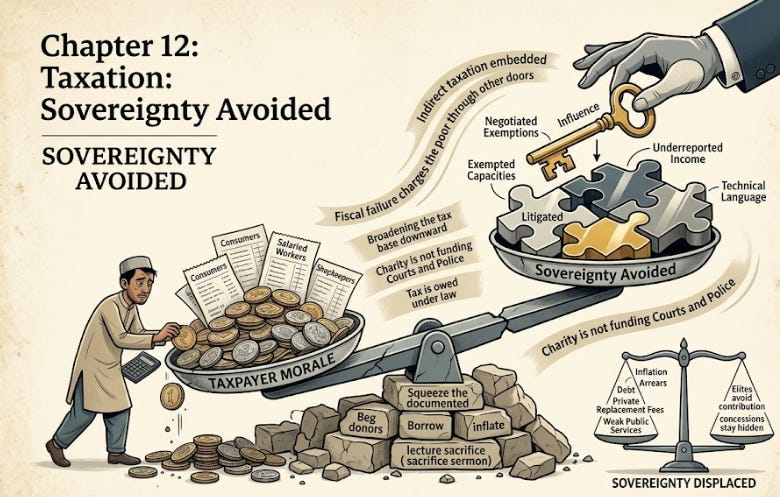
The salaried worker is taxed before the money reaches his hand. The shopkeeper with a till and a receipt book gets the notice. Larger pools of capacity stay underreported, negotiated, exempted, litigated, regularized, or buried in technical language. The burden does not vanish. It slides toward whoever is easiest to reach.
Taxation is the clearest test of whether a State is serious. A government that cannot tax capacity honestly cannot govern honestly. It can borrow, inflate, cut services, raise utility charges, squeeze the documented, beg donors, and lecture citizens about sacrifice. It cannot build a durable republic. Tax is not only revenue. Tax states who belongs, who owes, who benefits, and who is forced to carry costs others escape.
In a captured republic, taxation becomes the place where sovereignty is avoided. A State can be strong enough to tax the visible and too compromised to tax those with influence, complexity, informality, political protection, or legal engineering. Consumers pay through tax embedded in fuel, bills, imports, and daily necessities. A documented business gets examined because it has records, and the compliant taxpayer gets lectured because he answers the phone.
A fair system begins with capacity. Those with the greatest ability to contribute should not also be the most skilled at avoiding it. No enterprise, profession, or landholding grows entirely outside the State. Private success runs on public conditions: roads, currency, enforceable contracts, trained labor, ports, energy, courts. Taxation asks the successful to account for that dependence.
A republic needs enterprise, investment, and employment, and a crude system damages all of them: arbitrary enforcement frightens investment, complex compliance crushes small businesses, corrupt administration turns documentation into harassment. The argument has to be firm and careful at once: tougher on protected capacity, gentler toward ordinary compliance, widening the ledger without turning the tax office into another site of capture.
The captured order offers a false choice: tax harshly and blindly, or leave privilege alone in the name of economic survival. A republic refuses both. It builds taxation around visible capacity, clear rules, taxpayer rights, and honest accounting for how the money is spent.
“Broadening the tax base” deserves suspicion. Too often it means reaching the easiest new payer while the hard concentrations of capacity stay untouched. The base should expand upward and outward by capacity, not downward by reachability. Beginning with the smallest trader while large property gains, high professional earnings, connected wealth, and major agricultural capacity stay under-counted is extraction wearing reform’s clothes.
Indirect taxation is where this lands hardest. When the State cannot document income and wealth, it leans on what is easy to collect: consumption, fuel, utilities, transactions. Some of that is normal. As the default answer to weak direct taxation, it turns the burden invisible and unfair. A poor household may never file a return, yet pays through every purchase, every bill, and every inflationary consequence of fiscal weakness.
Dividing people into taxpayers and non-taxpayers misleads. A poor household pays through consumption, utility charges, inflation, user fees, and the collapse of public services that forces private spending. A patient who buys medicine outside a public hospital pays again. A parent paying private fees because the public school failed pays again. A family buying generator fuel, water, or private security pays again. Fiscal failure does not spare the poor. It charges them through other doors.
The powerful avoid this by narrowing the definition of contribution. They ask who files a return, not who carries the burden. They ask whether citizens will sacrifice, not whether sacrifice is shared by capacity. The real question is who pays for the State’s weakness.
Exemptions are where the question turns concrete. Some are defensible: protecting vulnerable groups, avoiding double taxation, serving a genuine policy goal. Every exemption has a cost and a beneficiary. A tax concession is public money not collected, which makes it public spending by another route. If the State surrenders revenue for a purpose, citizens deserve the rationale, the fiscal cost, the duration, and the evidence of public benefit.
Budgets show what the State spends; tax expenditures show what it gives up through exemptions, reduced rates, concessions, amnesties, and special regimes. Without that ledger, privilege hides in the negative space of the budget. Citizens see underfunded schools, hospitals short of medicine, and rising debt, while the revenue surrendered to protected categories stays off the page.
Amnesties are the sharpest version of the harm. There may be rare cases for a one-time disclosure scheme inside a real reform, but repeated amnesties teach the wrong lesson. They tell the compliant taxpayer that obedience was foolish and the evader that waiting pays. They convert illegality into a negotiable settlement. If they are used at all, they should be exceptional, justified in public, tied to permanent documentation, and followed by credible enforcement. Otherwise they are ceremonies of surrender.
Tax administration must answer for itself too. Citizens comply when the authority is predictable, lawful, and correctable. A captured tax authority turns predatory: vague notices, audits used as pressure, refunds delayed, small errors punished harshly, discretion sold. That behavior pushes activity underground and hands ammunition to everyone who resists documentation. Fair taxation needs taxpayer rights: clear notices, written reasons, appeal routes, refund timelines, a real distinction between error and fraud, and simple compliance for the small.
Documentation has to be built intelligently. A micro-enterprise, a farmer, a freelancer cannot be forced through systems designed for large corporations without support and transition. The goal is progressive formalization, not administrative ambush. Digital tools help, but a portal without explanation, correction, and appeal becomes another wall, and a new market for consultants, agents, and facilitation fees. Documentation should make economic life visible and fair, not manufacture fear.
Professional income tests fiscal seriousness. Doctors, lawyers, consultants, accountants, engineers, real estate brokers all want respectability, and respectability should not become invisibility. A class that demands roads, courts, hospitals, and a stable currency must also accept fair documentation of income, with genuine expenses and due process respected. Status is not an exemption from contribution.
Agriculture needs more care, because the category holds both the vulnerable and the powerful. Treating all farming as one moral unit is bad policy and bad justice. A small farmer facing weather, debt, and weak bargaining power is not a large landholder with political reach and asset wealth. A defensible framework distinguishes scale, income, crop value, irrigation, and tenancy, so genuine capacity cannot hide behind the image of the small farmer.
Property carries the same problem. Land stores wealth created partly by public action: roads, utilities, zoning, security, nearby development. When public investment lifts private land values, the public has a fair claim to a share through careful, lawful means. Large untaxed gains in land deepen inequality, fuel speculation, and starve the services everyone uses. A country that cannot tax visible property fairly will never tax hidden income credibly.
Public contractors and concession recipients deserve the closest scrutiny, because they take value directly from the State. A company earning from public contracts, subsidies, guarantees, licenses, or land allotments should not be invisible to tax accounting. Public money should not flow to entities whose ownership, compliance, and performance are opaque.
Tax morale also depends on what happens to the money. Citizens resist when they expect it to be stolen or wasted, and that distrust is not irrational. If they see luxury, opaque procurement, failing public enterprises, and no consequence for misuse, they ask why they should give more. The State cannot demand fiscal obedience while treating public money as private fuel. Public money is amanah, a trust held for others, requiring a record of what was taken and where it went. Collection and spending are bound together by that trust.
Religious language cannot be selective here. A society cannot praise charity while tolerating evasion, or invoke trust while hiding public money. Zakat and charity have their place, but voluntary giving cannot fund courts, police, hospitals, schools, and debt service. Charity is chosen by the giver and follows his preference. Tax is owed under law and follows the public budget. A wealthy man who donates in public but evades lawful tax has not met the same obligation by another route. Generosity relieves suffering. Taxation finances duty.
The duty runs both ways. Citizens do not owe blind trust to a captured treasury. They owe lawful contribution, and the State owes lawful accounting, the hisab or reckoning for what was collected and how it was used. The taxpayer must not hide capacity. The State must not hide its spending. Evasion is not cleverness, and collection is not a license to waste.
When the State will not tax capacity openly, citizens still pay anyway. Through inflation, an invisible tax on those least able to defend themselves. Through debt, a charge on future citizens who never voted for today’s privileges. Through arrears that become private distress for contractors, workers, and pensioners. The form changes; the burden does not.
If elites avoid contribution, the public pays elsewhere. If concessions stay hidden, budgets shrink elsewhere. The ledger never disappears. It moves to whoever lacks the influence to look away.
A recovered republic starts with fiscal truth: who pays directly and who pays indirectly, which sectors are documented and which are not, which exemptions exist and what they cost, which groups take more from the State than they give and which carry the burden without a voice. Without those answers, policy is theatre.
The reform agenda follows. An annual tax expenditure statement should name every major exemption with its estimated fiscal cost; the public then sees what was surrendered and to whom. The burden map should span direct and indirect tax, showing where the two overlap on the same household. Documentation of high-capacity sectors needs strengthening while compliance for small taxpayers is simplified; public contractors and concession recipients should be tied to compliance and beneficial-ownership disclosure. Property and land-value taxation should improve, with protections for small owners and a real distinction between subsistence agriculture and large-capacity landholding. Local revenue and local spending should sit side by side in every public budget, so citizens can trace payment to service.
Sequence decides whether it reads as legitimacy or extraction. Start where capacity is large, public value is visible, and records can be built: contractors, high-value property, large concessions, major exemptions, repeated amnesties, luxury consumption, high-income professions. Bring small taxpayers in through simplification and trust, not as the symbolic battlefield while bigger privilege stays protected. Begin with the weakest visible payer and it looks like extraction. Begin with protected capacity and it begins to restore legitimacy.
People do not become good taxpayers through sermons. They comply when contribution and benefit are connected by records: roads repaired, schools teaching, hospitals stocked, complaints acknowledged, the ward project board posted. Pay and see nothing, and resentment hardens. Pay and see a ledger, and the fiscal relationship starts to change.
Every budget speech promises sacrifice, reform, and relief. The question is what happened after: whether exemptions were reviewed, amnesties avoided, concessions costed, refunds paid on time, audit powers controlled rather than abused. Without follow-up, the fiscal language is ritual.
Taxation is a civic mirror. It shows whether the State has the courage to confront power, whether the poor pay invisibly while the wealthy contribute visibly, and whether public spending can defend itself.
The working tools for this chapter are at https://thecapturedrepublic.org/appendix/j-tax-expenditure.html. The page holds a tax-expenditure tracker for logging named exemptions with their estimated fiscal cost, a household burden worksheet totalling what a family pays through indirect tax and private replacement of failed services, and a taxpayer-rights checklist for contesting an unfair notice.
Where public money is meant to go was set down directly:
”What Allah has bestowed on His Messenger (and taken away) from the people of the townships, belongs to Allah, to His Messenger and to kindred and orphans, the needy and the wayfarer; in order that it may not (merely) make a circuit between the wealthy among you.”¹
A captured order says, “We need more revenue,” while dodging every hard question about capacity, exemptions, spending, and trust.
A republic says, “Show who pays, show who benefits, show what was forgiven, show what was spent, and show what the citizen received.”
Taxation as sovereignty. Anything less is sovereignty avoided.
Postscript Reference
¹ Qur’an 59:7 (Surah Al-Hashr), trans. Abdullah Yusuf Ali (1934).