
Chapter 10: The Myth of the Single Savior
The Captured Republic

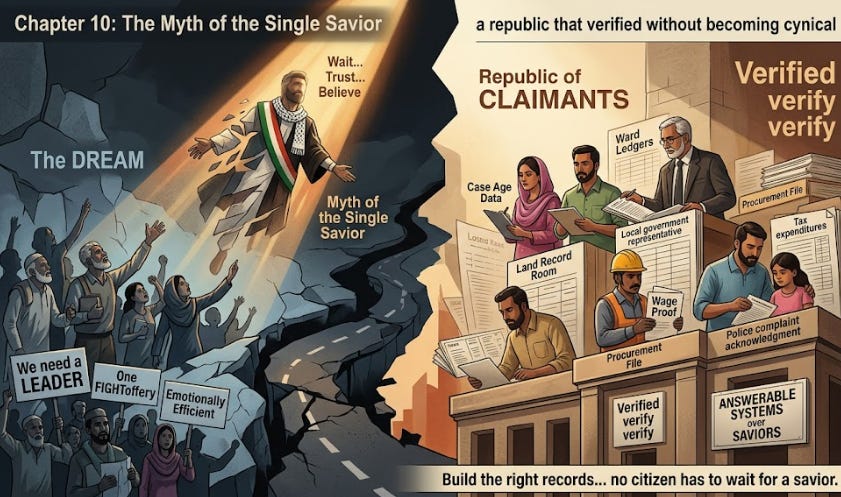
Chapter 10: The Myth of the Single Savior
A captured society starts to dream of rescue. After enough delay, humiliation, corruption, broken promises, failed committees, weak courts, uneven policing, unfair taxes, stolen land value, unpaid wages, failing hospitals and schools, and private exhaustion, citizens begin to search for one figure who can cut through everything. One leader. One judge. One general. One party. One cleric. One technocrat. One billionaire. One activist. One foreign-backed reformer. One honest officer. One election. One intervention. One moment that will finally force the system to change.
The dream is understandable. People are tired. They have watched ordinary routes fail, files sleep until someone powerful calls, scandals dissolve into committees, and elections produce new slogans on old methods. Leaders promise reform and inherit the same bargain they once condemned. Institutions speak of dignity while ducking answerability. In such a climate, the idea of one savior feels emotionally efficient. It collapses a complicated republic into one face, one will, one fight, one hope.
But the single savior is one of the most dangerous myths in a captured order, because it preserves the same dependency it claims to defeat. It tells citizens the problem is not the structure of unanswerable power but the absence of a sufficiently pure, brave, strong, wise, or ruthless person at the top. A civic problem becomes a personality problem. The public is asked to wait again, trust again, believe again, forgive delay again, suspend judgment again, because this time the right person has arrived.
A republic cannot be rebuilt on that emotional bargain.
Leaders count. A society needs capable leadership, moral courage, administrative competence, political judgment, legal reform, institutional discipline, and people willing to use authority for public purpose. Bad leaders can damage a country quickly. Good leaders can open space, set direction, protect reformers, discipline institutions, and make honest work possible. But leadership is no substitute for answerable systems.
A leader who fixes individual problems without changing the channel of power becomes a better patron, not the builder of a republic. If citizens still need his personal attention to move files, obtain justice, get medicine, claim wages, protect inheritance, expose contracts, or get a police response, the system has not been repaired. It has only found a more attractive face. After every savior, the real test is not how sincere he sounds, but what works when he is absent.
The myth is powerful because captured systems make the ordinary route feel too slow. Citizens want immediate relief, and often they need it. A patient cannot wait for procurement reform, a worker for the redesign of labor institutions, a woman pressured over her inheritance for cultural change, a resident living with sewage for a national settlement on local government. Urgency is real. But it should lead to service guarantees, claimant protection, fast remedies, and emergency accountability, not back into dependence on heroic discretion.
The captured order can absorb saviors more easily than citizens imagine. It flatters them, isolates them, overloads them, surrounds them with old networks, feeds them partial information, blames every obstruction on enemies, and turns their slogans into branding while the channels of privilege stay intact. A political savior learns the cost of taking on every protected group at once. The judicial one is simply waited out. With a general, the system borrows his authority and skips the public accounting. The technocrat vanishes inside data and procedure. Praise the religious figure for his moral language, and property, wages, and tax stay untouched. For the media figure, exposure curdles into spectacle while the system waits for the next story.
The savior may not even be corrupt. He may be sincere and still fail, because sincerity cannot replace institutional design. A leader who builds no records leaves citizens dependent on his word; one who builds no service guarantees leaves them dependent on his courage; one who never asks for a ledger can stir a nation’s conscience without shifting any power. The dependency only changes its object. It does not end.
The single-savior myth also turns citizens into spectators. A public that watches, waits, defends, attacks, excuses, and hopes starts to measure politics by loyalty to the person rather than discipline of method. Every criticism becomes betrayal, every delay sabotage, every missing record a distraction. Failures are blamed on enemies; compromises are recast as strategy. The citizen who should be asking for proof becomes a defender of the leader’s intent. Behind the personality, the republic disappears again.
The citizen who once begged the local patron now attaches himself emotionally to the national one. Clientship returns through hope. He may speak the language of revolution, reform, justice, accountability, or national renewal, but his posture stays dependent. He waits for someone else to carry the burden of citizenship. He wants the leader to punish the corrupt, fix the courts, clean the police, reform tax, protect women, discipline the bureaucracy, restore the schools, repair the hospitals, and revive the economy, while citizens stay organized mainly as supporters, not claimants.
A captured republic cannot be repaired by supporters alone. It needs claimants.
Supporters defend a person. Claimants defend a standard. Supporters ask whether their leader is winning. Claimants ask whether the record exists. Supporters excuse delay because the enemy is strong. Claimants ask for timelines. Supporters accept verbal promises because they trust the leader. Claimants ask for written reasons, published data, and follow-up. Supporters often apply accountability outward. Claimants apply it across sides, including their own. A movement of supporters may win power. A movement of claimants can rebuild a republic.
The myth lets every group outsource the moral work. Citizens condemn corruption but expect one leader to confront it. Families praise justice while keeping a daughter’s inheritance hidden at home. Employers call for national reform while delaying their own workers’ wages. Professionals want institutional dignity while keeping their accounts opaque. The press demands transparency while hiding its dependencies; the pulpit preaches morality while keeping no ledger of its own. Each group gets to imagine the country’s problem sits somewhere else, waiting for a powerful figure to defeat it.
A serious republic begins when every site of power is asked to answer. The leader must answer, but so must the office, the court, the police station, the land record room, the tax authority, the hospital, the school, the press, the business, the family, the mosque committee, the charity, the union, the public enterprise, and the local council. None of that burden can keep being shifted upward. Elite capture is strongest at the top, but it survives through a chain of smaller silences. A savior at the top cannot repair what a society keeps excusing below.
None of this means citizens should avoid leadership or refuse political choice. Elections count. So do parties, courts, public appointments, and administrative leadership. A country should choose better people where it can. But the citizen must not trade method for hope. The right question is not only who should lead, but what the leader will make answerable. Will public land be counted? Will tax breaks be published? Will procurement files be open? Will court delay be measured? Will every police complaint be logged? Will hospitals show their medicine stock? Will wages be proven paid? Will daughters receive their inheritance?
These questions are the antidote to savior politics. They turn hope into conditions.
A leader who accepts these conditions may deserve support. One who refuses them but asks for trust is asking citizens to stay clients. Trust has a place in public life, but it cannot be the operating system of a republic. It has to rest on records, law, timelines, remedies, audits, and public memory. A society that trusts without verifying becomes easy to manage. A society that verifies without turning cynical becomes hard to capture.
Savior politics runs on a cycle of inflation and collapse. A figure rises. Expectations become impossible. Followers tie their own identity to his success, opponents become enemies of the nation, and every compromise is denied until it can no longer be denied. Institutions are judged by whether they help or hinder the figure. Setbacks are explained as conspiracy, doubts as disloyalty. Eventually he disappoints, is removed, is absorbed, is defeated, or hardens into another center of power. Hope collapses into cynicism, and the country ends up more distrustful than it began.
Captured systems feed on this cycle. They would rather citizens swing between worship and despair than build slow habits of accountability. Worship suspends scrutiny. Despair prevents work. Public accounting asks for a different emotional discipline. It does not ask citizens to stop caring. It asks them to care in a way that survives disappointment. When one leader fails, the ledger remains. When one officer is transferred, the service standard remains. When one court changes, the delay data remains. When one scandal fades, the follow-up record remains. When one party falls, the public demand remains.
The republic after capture has to be built so that good leadership helps and bad leadership cannot wipe everything out. That means institutions that remember: laws that demand reasons, courts that measure time, police stations that log every complaint, budgets that show every concession, land records that name public value. A savior may open the door. Only systems keep it open.
A deeper danger hides in the wish for a savior above restraint. Frustrated by delay, citizens start to admire force without asking what that force will answer to. They want someone who can bypass procedure, crush opposition, ignore courts, silence critics, seize property, punish enemies, and impose order. The wish comes from real frustration, and it reproduces the deepest logic of capture: power without answerability. A republic should worry when its citizens begin to say the system needs a strong hand more than it needs accountable law. The strong hand may strike the enemy today and the citizen tomorrow.
Procedure is slow only when it is badly designed or captured. Done well, it is how power is kept safe. Due process protects citizens from false accusation, written reasons from arbitrary refusal, appeals from first-desk power, evidence from rumor, privacy from exposure, timelines from delay. The answer to captured procedure is procedure that answers, not lawless force.
Distributed answerability is the alternative to the savior. Let leaders lead, but make them publish records. Let courts judge, but make them account for time. Let police protect, but make them log every complaint. Let businesses profit, but make them pay wages and taxes in the open. Let families keep their peace, but not at the cost of a daughter’s property. Let citizens demand reform, but make them hold their own side to the same standard they demand of everyone else.
Answerability never satisfies the way a rescuer does. The work is harder and slower and more serious. It trades instant national drama for repeated civic pressure, and one leader’s purity for millions of small refusals to accept silence as an answer. The hope stays. It just attaches to mechanisms instead of personalities.
A country may still need courageous leaders, and it will. But the leader worth following does not make a nation need him forever; he builds systems that keep answering after he is gone: the judge who widens the road to justice instead of guarding its only door, the officer who moves the ordinary file without being asked, the activist who builds claimants instead of followers, and the reformer who leaves the ordinary route stronger than he found it.
If capture works through hidden channels, the next task is to open the ledgers where those channels become visible: land, taxation, public money, procurement, public enterprises, courts, police, bureaucracy, local government, the press. A country does not need one savior standing above all these systems. It needs each of them forced to answer in its own record.
A captured order says, “Wait for the right person.”
A republic says, “Build the right records, duties, timelines, remedies, and protections so no citizen has to wait for a savior.”